
Blog
Affordability Refugees: How Cross-Metro Home Shopping Is Reshaping U.S. Housing Demand
7 min read
August 26th, 2026
What the data says: cross-metro shopping is now the norm
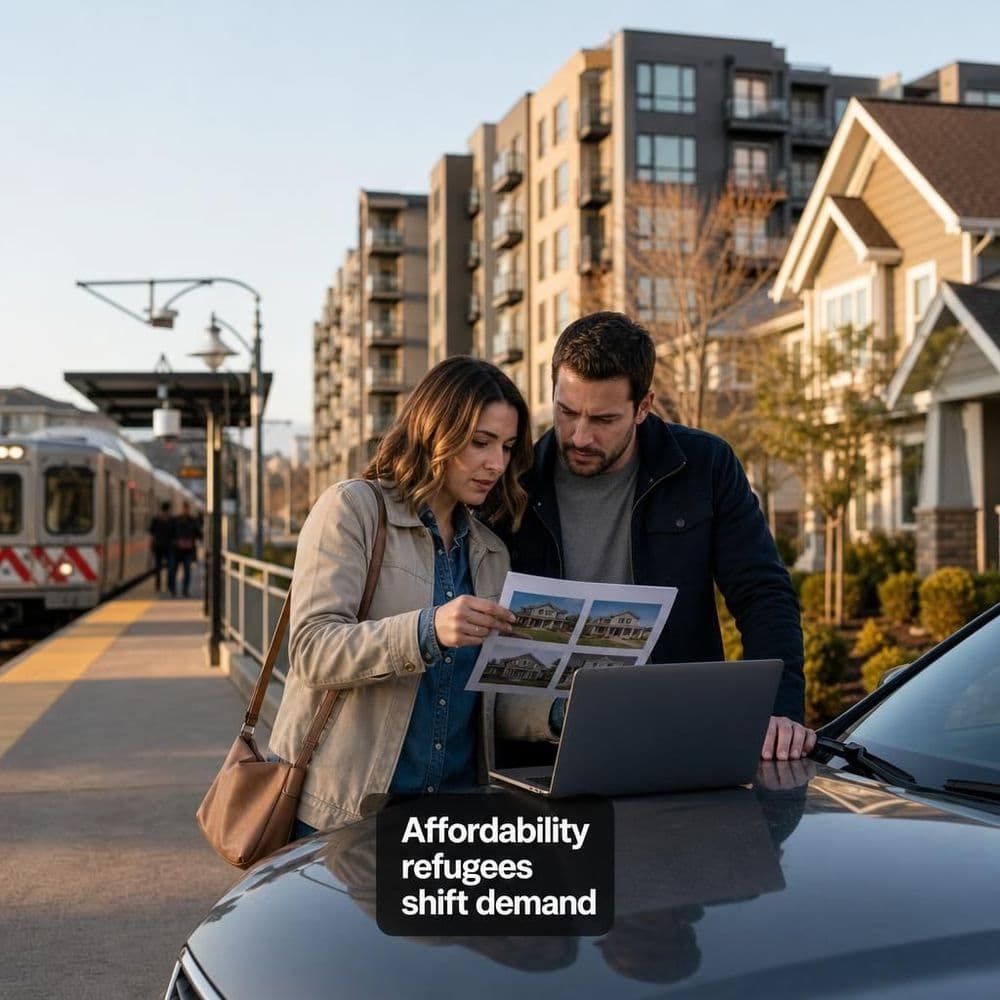
A growing share of U.S. homebuyers are becoming what some analysts call "affordability refugees": shoppers who stay in the hunt, but expand their search beyond the metro where they currently live. The latest Realtor.com cross-market demand data suggests this is no longer a niche behavior—it’s a mainstream feature of today’s housing market.
In the second quarter of 2026, 60.1% of online home views on Realtor.com from the 100 largest metros went to listings outside the shopper’s local market, up from 48.2% in the pre-pandemic second quarter of 2019 (and slightly above 59.1% a year earlier). [mediaroom.realtor.com]
That change matters because it doesn’t just shift *where* buyers look—it can shift *where demand lands*. When large metros export shoppers, nearby or lower-cost markets can receive incremental demand even if national sales are sluggish.
Where it’s most pronounced: regional splits and the West’s lead
The regional differences are stark. Realtor.com reports that nearly two-thirds of home views originating in Western metros went out of market in 2026 Q2, compared with 59.8% in the South, 58.3% in the Northeast, and 56.1% in the Midwest. [mediaroom.realtor.com]
Importantly, Realtor.com also notes that some lower-cost metros keep more shoppers "local." In those markets, relative affordability can act as an anchor—retaining residents who might otherwise leave the metro entirely while still attracting interest from higher-priced areas. [mediaroom.realtor.com]
The new map of "nearby affordability"
Cross-metro shopping isn’t only about moving to a different state or chasing a dramatically cheaper cost of living. In many cases it’s about finding a nearby market with meaningfully lower prices—often within a commutable distance.
Realtor.com highlights examples such as Salt Lake City, Denver, and Durham, where shoppers increasingly look to adjacent metros like Ogden, Colorado Springs, and Raleigh for lower prices and potentially more space for the same budget. [mediaroom.realtor.com]
Local reporting in Utah illustrates how that plays out: Deseret News notes that cross-market house hunters now account for about 60% of buyers in the nation’s 100 largest metros, and that Salt Lake City-area shoppers often look toward Ogden as a cheaper alternative. It also cites July pricing from the Utah Association of Realtors showing Salt Lake County’s average sales price at $694,113 (up 6.1% year over year) versus Weber County at $520,969 (down 5.2% year over year). [deseret.com]
These "nearby affordability" flows can create second-order effects—supporting demand in recipient metros while changing the composition of buyers in origin metros (more high-income buyers or investors who can still afford to compete).
What to watch next in local markets
A few indicators help translate cross-metro browsing into real market outcomes:
- **Conversion:** Are out-of-market views turning into pending sales, or is this mostly "wish-list" shopping?
- **Recipient-market inventory:** If inventory stays tight, even modest inbound interest can keep prices sticky.
- **Payments:** Mortgage rates still set the monthly budget. Freddie Mac’s PMMS shows the average 30-year fixed rate at 6.65% as of August 20, 2026. [freddiemac.com]
The big picture: affordability pressure is increasingly expressed as *geographic substitution*. When a buyer can’t make the numbers work in one metro, the next search is often not "stop shopping"—it’s "shop somewhere else."
Comments