
Blog
Affordability Squeeze Deepens as Home Prices Outrun Incomes (and Rates Stay Elevated)
7 min read
June 14th, 2026
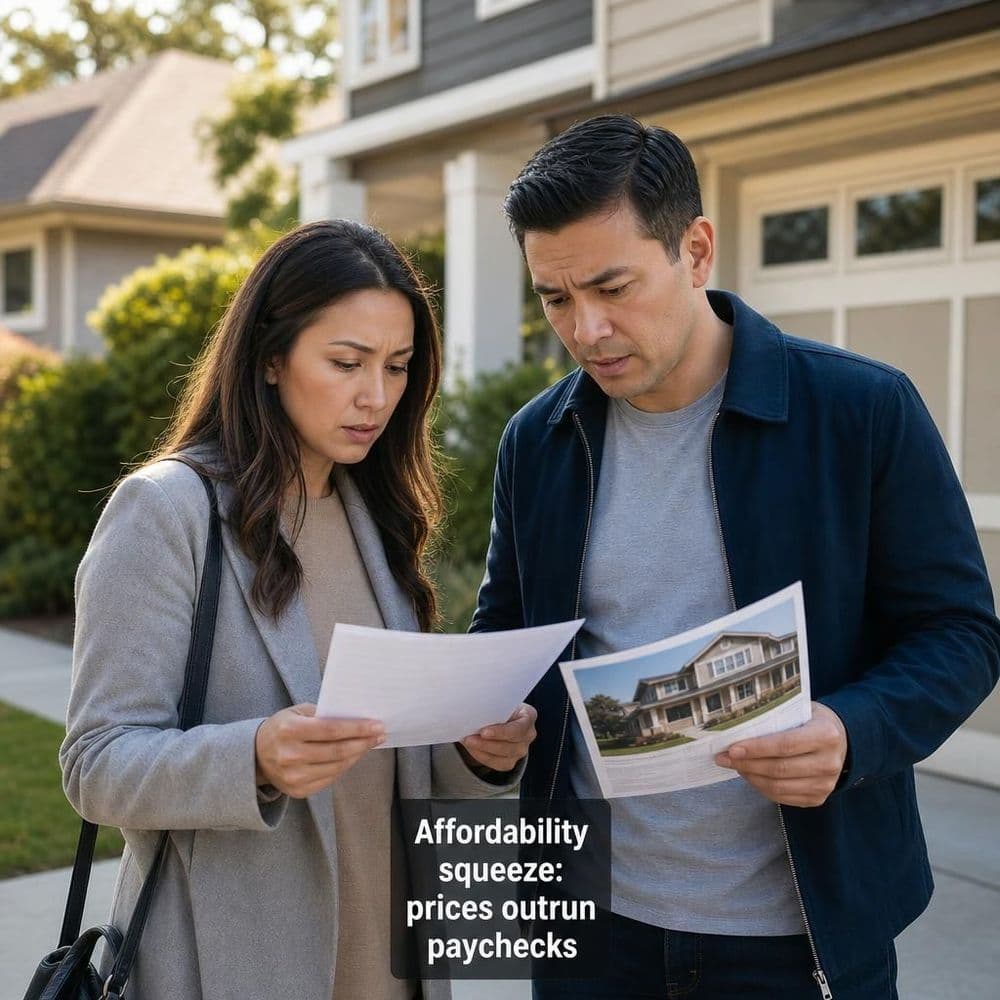
What the affordability squeeze looks like on the ground
Housing affordability is often discussed in charts, but the buyer experience makes the tradeoffs obvious: higher monthly payments, less certainty, and more compromises. In a recent first-person account, a Bay Area buyer describes repeatedly losing bids and learning that the list price can be a poor guide to the eventual sale price. Their budget began around $1.2 million, later rising to $1.5 million after expanding the search outside the city, yet they still encountered homes selling far above asking. [businessinsider.com]
A key theme is ‘budget creep’: buyers start with a number that feels responsible, then steadily raise it as they calibrate to the market—until they hit a personal red line. That dynamic can keep demand alive even when affordability is deteriorating, because many households try to “make it work” before stepping aside. [businessinsider.com]
Rates are adding pressure to already-high prices
Even when home-price growth cools in some places, affordability can worsen if financing costs climb. Realtor.com reported that mortgage rates rose 4 basis points to 6.52% for the week it cited from Freddie Mac—small in isolation, but meaningful when layered on top of high home prices and tight budgets. [realtor.com]
Because so much of the monthly payment is interest-heavy in the early years of a mortgage, buyers are highly sensitive to rate changes. In practical terms, a modest move higher can be the difference between qualifying for a loan or not, or between feeling comfortable and feeling “house poor.” [realtor.com]
The supply and preservation problem behind the squeeze
Affordability pressure isn’t only about today’s mortgage quote. HousingWire’s interview with LISC’s CEO underscores a broader structural issue: housing costs rising faster than wages, higher operating costs (including insurance), and an aging housing stock that’s costly to preserve. LISC’s reporting also frames the challenge as a shortage on the order of millions of units, which helps explain why pockets of demand can keep prices elevated even as buyers feel stretched. [housingwire.com]
When supply is limited, the market effectively “ration[s]” housing through price and payment. That pushes first-time buyers to wait longer, trade down in size or location, or remain renters longer than planned. [housingwire.com]
New financing tools: helpful, but limited in scale
One promising development is targeted financing that helps create attainable for-sale inventory. In Denver, HousingWire reported that the Colorado Housing and Finance Authority closed a $5.7 million low-interest construction loan for Wolff Street Flats, a 23-unit affordable condo project. Homes are expected to average about $285,000 and target buyers under 80% of area median income, with completion projected for August 2027. [housingwire.com]
These kinds of programs can reduce financing costs for builders and, in turn, lower the price point for buyers—especially in condo formats that use land more efficiently than detached homes. But the scale question is unavoidable: a few dozen units are meaningful for the households who get them, yet small relative to metro-wide demand. [housingwire.com]
What to watch next
Over the next few months, keep an eye on three indicators. First: whether inventory grows specifically in “attainable” price tiers, not just at the top of the market. Second: whether new-construction and condo pipelines meaningfully add supply in job-rich metros. Third: whether specialized financing programs expand their capital base and move from pilot-scale unit counts to repeatable volume.
For buyers, the near-term reality is that affordability is being pulled in two directions: rates can change quickly, while supply takes years to build. That mismatch is why the squeeze can persist even when the market isn’t “hot” in every headline.
Comments