
Blog
AI wealth is reshaping San Francisco housing again: prices near $1.725M and the affordability gap widens
7 min read
July 25th, 2026
What’s driving the rebound in San Francisco
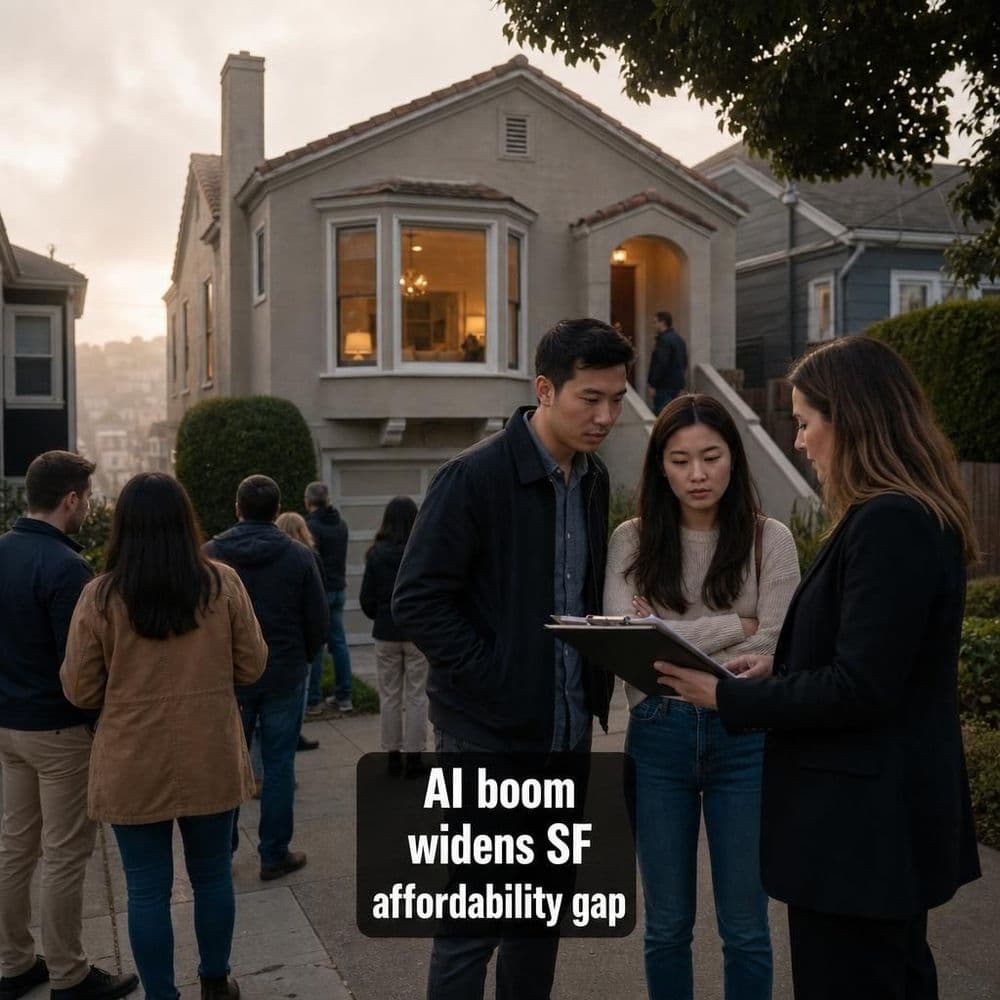
San Francisco’s housing market is showing a classic late-cycle squeeze: demand is accelerating while supply stays tight. Local agents describe a market where well-compensated tech and AI buyers can move quickly, put down large down payments, and stay competitive even when mortgage rates are elevated. That makes rate changes feel less decisive than they do in more payment-sensitive markets. [cbsnews.com]
At the same time, the city is seeing renewed interest from buyers who want to be close to the region’s tech ecosystem, and some sellers are benefiting from that shift as multiple-offer situations return. [cbsnews.com]
The numbers behind the run-up
Redfin’s analysis of MLS data shows just how dramatic the rebound has been over the long run. The San Francisco metro median sale price bottomed at $625,000 in March 2012 and reached $1.7 million by March 2026—crossing a $1 million gap for the first time. By June 2026, the median sale price was about $1.725 million. [stocktitan.net]
On a year-over-year basis, Redfin reports June 2026 prices were up 9.2%, while home sales rose 23% and new listings fell 16%. That combination—higher demand and fewer new listings—helps explain why buyers are seeing fewer “reasonable” opportunities and more bidding-war dynamics. [stocktitan.net]
Other reporting using the same Redfin figures frames San Francisco as one of the country’s most supply-constrained, high-demand markets: June 2026 sales up significantly with new listings shrinking, consistent with a tightening market. [mansionglobal.com]
Why the suburbs can look different
Bay Area housing right now can feel like two separate markets. In San Francisco, agents describe intense competition for the limited number of listings, including examples of homes selling in days and well above asking. Outside the city, some communities appear far more rate-sensitive, with longer time on market and price reductions. [cbsnews.com]
The practical takeaway: when high-income demand concentrates in the urban core, the “pressure valve” often shifts outward—but only after the city becomes unaffordable even for higher earners, or when rates meaningfully change monthly payments. [cbsnews.com]
What this means for affordability
This rebound isn’t just about a higher median—it’s about who can still compete. In markets where equity compensation and large cash positions play a bigger role, the affordability gap can widen quickly because conventional, payment-driven buyers can’t stretch as far. Redfin also characterizes San Francisco as a tight seller’s market driven by high-income AI-sector buyers who can remain competitive. [mpamag.com]
Even the “hypothetical” scenarios underscore the scale of wealth at the top end: Redfin estimated that, in theory, current and former employees of two major AI firms could collectively buy nearly one-third of all homes in the San Francisco metro area with IPO-related equity proceeds (a purely illustrative exercise, not a forecast). [redfin.com]
Practical takeaways for buyers and sellers
**For buyers:**
- In a low-inventory, multiple-offer environment, speed and certainty matter. Strong pre-approval, larger down payments, and fewer contingencies can be decisive—especially when competing with cash-heavy offers. [cbsnews.com]
- If you’re priced out of the city core, broaden the search early (neighborhoods, condo vs. single-family, or adjacent counties) rather than waiting for a perfect listing that may draw a bidding war. [cbsnews.com]
**For sellers:**
- When demand is surging and listings are scarce, presentation and pricing still matter—but you may have more leverage on terms (closing timeline, rent-back) than in balanced markets. [cbsnews.com]
**What to monitor next:**
- New listings and active inventory: the fastest way for a hot market to cool is for more supply to show up. [stocktitan.net]
- Mortgage rates: even if top-end buyers are less sensitive, broader affordability is still rate-driven nationally. Freddie Mac’s PMMS showed the average 30-year fixed rate at 6.58% as of July 23, 2026. [freddiemac.gcs-web.com]
Comments