
Blog
How New Cooling Mandates and Habitability Rules Are Rewriting Rental Landlord Obligations
9 min read
December 31st, 2025
From basic shelter to health-focused housing standards
Across many U.S. markets, the definition of a “habitable” rental is shifting from basic shelter toward broader health and safety outcomes. Instead of only requiring heat, hot water, and functioning plumbing, local governments are starting to ask whether homes protect residents from extreme heat, food insecurity, and chronic disrepair.
This shift shows up in three main ways: direct mandates for cooling, clearer minimum requirements for kitchens and appliances, and a move toward proactive rental inspections rather than complaint-only enforcement. Together, these tools put more day-to-day responsibility on landlords to maintain healthy indoor conditions – and they raise the cost of operating marginal properties.
Cooling mandates in Los Angeles County: a new baseline for indoor comfort
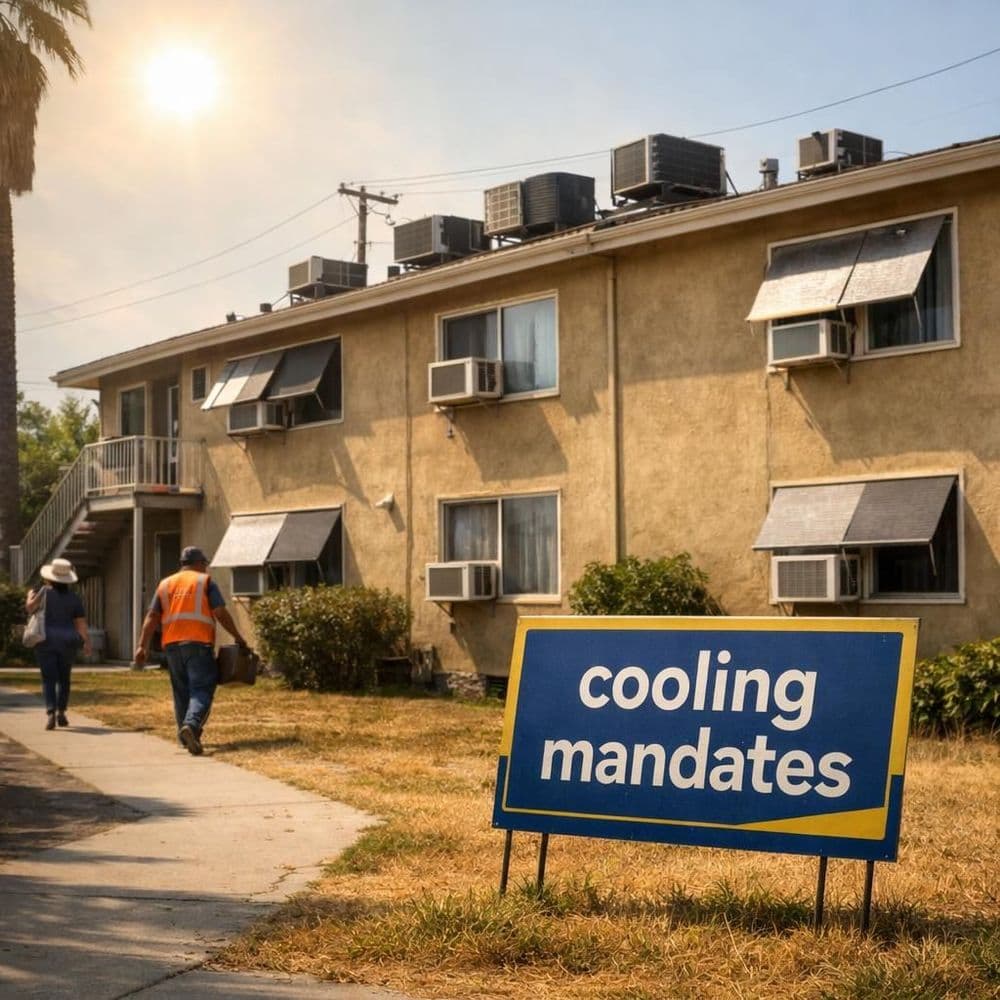
Los Angeles County is a leading example of health-focused habitability rules. In 2025, county officials approved a measure that will require most rental units in unincorporated areas to be kept at or below a specified indoor temperature – widely reported as 82 degrees – during hotter periods.[laist.com] The rule responds to rising heat-related illnesses and deaths, particularly among lower-income renters living in older buildings without air conditioning.
Under the policy, owners must install or maintain cooling systems capable of keeping units within the temperature standard, with some flexibility for properties where central air is not feasible.[laist.com] Many smaller apartment buildings and older single-family rentals that rely on fans, open windows, or aging wall units will need upgrades.
For landlords, the implications include:
- **Capital costs** for installing or replacing air-conditioning units, upgrading electrical capacity where needed, and weatherizing buildings so cooling systems can perform.
- **Operating costs** tied to higher electricity use and increased maintenance on cooling equipment.
- **Compliance risk**, as failure to meet the temperature standard could expose owners to fines, enforcement actions, and potentially habitability claims.
The takeaway: in hot-climate markets watching Los Angeles County, landlords should expect indoor temperature standards to join heat and hot water as baseline obligations, not amenities.
Appliance and kitchen requirements: redefining a "habitable" apartment in California
California is also tightening what counts as a habitable home at the state level. A new state law, Assembly Bill 628, will require that most rented homes include a functional kitchen and refrigerator starting January 1, 2026.[eladelantado.com] Until now, state law required basic services like hot water and heating but left major appliances in a gray area, allowing many landlords to rent units without stoves or refrigerators.[eladelantado.com]
By folding a working kitchen and refrigerator into the legal habitability definition, the law effectively reclassifies these appliances from optional luxuries to necessities. For tenants, that means fewer move-in surprises and less need to spend thousands of dollars on basic equipment just to store food safely and prepare meals.
For owners, the law has several practical effects:
- **Upfront capital**: providing and maintaining a stove and refrigerator in every covered unit, including retrofits for units historically leased without appliances.
- **Turnover planning**: building in time and budget to repair or replace appliances between tenancies, and tracking useful life in capital plans.
- **Lease structure**: clarifying in leases who is responsible for minor repairs versus full replacement, and documenting the condition of appliances at move-in.
In markets where tenants were previously expected to bring their own appliances, this is a meaningful shift of cost and responsibility from renters to landlords.
Proactive rental inspections: Detroit, Isla Vista, and beyond
At the same time, a growing number of cities and counties are moving from complaint-driven code enforcement toward proactive inspection programs. Rather than waiting for tenants to report problems – which many are reluctant to do – these programs seek to identify substandard conditions before they become emergencies.
Detroit’s updated rental ordinance
Detroit has long required rental properties to obtain a certificate of compliance, but many units have historically operated outside the formal system. In 2025, the city launched a pilot phase of a new rental ordinance that simplifies the certification process and encourages landlords to get homes inspected.[detroitmi.gov] The city emphasizes a streamlined checklist and phased rollout across ZIP codes to bring more units into compliance.
For landlords, Detroit’s approach highlights a trend toward:
- **Standardized inspection checklists** focused on core health and safety metrics.
- **Time-limited certificates**, requiring periodic reinspection to maintain rental status.
- **Administrative penalties** for renting without a valid certificate, increasing the cost of noncompliance.
Isla Vista’s contested inspection program
In Santa Barbara County’s Isla Vista community – a dense, student-heavy rental market – a one-year pilot inspection program was approved in 2025 to proactively inspect rentals for health, safety, and unpermitted construction issues.[independent.com][noozhawk.com] The program requires landlords to register their units and allow county inspectors to periodically check interiors, using a checklist that covers items such as smoke alarms, mold, illegal garage conversions, and basic structural conditions.[independent.com]
Landlord groups have sued to halt the program, arguing that aspects of the ordinance conflict with state entry and privacy rules and could lead to loss of marginal units if illegal bedrooms and conversions must be removed.[independent.com][noozhawk.com] A county judge has allowed inspections to proceed while litigation continues, and early inspections have focused on minor issues like peeling paint and missing smoke detectors rather than major life-safety violations.[noozhawk.com]
Regardless of how the lawsuit is resolved, Isla Vista illustrates how proactive inspection regimes can surface long-standing code issues and force difficult decisions about whether to upgrade, reconfigure, or take units offline.
Emerging tenant protection ordinances and local oversight
Beyond individual programs, some counties are adopting broader tenant protection ordinances that tighten standards and narrow exemptions. In Sonoma County, a Residential Tenancy Protections Ordinance supplements state law by expanding just-cause and other protections to additional categories of units that were previously exempt, and by clarifying limits on certain termination and rent-increase practices.[sonomacounty.gov] While not a cooling or appliance mandate, it is part of the same larger movement: treating stable, safe tenancies as a core policy goal and scrutinizing rental practices that undermine that stability.
Elsewhere, city leaders are publicly reassessing their enforcement models. A 2025 hearing in Philadelphia focused on rental code enforcement, repairs, and the potential for a proactive inspection program to ensure safe, healthy homes.[phlcouncil.com] Labor and community groups there highlighted how weak enforcement and deteriorating rental conditions contribute to health problems and housing instability for working families.
The common thread is tighter oversight of rental conditions and a willingness to move from reactive to proactive enforcement, especially in lower-income neighborhoods where tenants often have limited leverage.
Playbook for landlords and investors: getting ahead of habitability risk
For landlords and investors, these policy changes are not just legal footnotes – they alter the economics of owning and operating rental property, particularly in older buildings. A few practical steps can help operators stay ahead of the curve:
- **Map your exposure**. Identify which properties fall under new or upcoming rules: LA County’s cooling requirement, California’s appliance mandate, Detroit’s certification rollout, or local tenant protection ordinances. Build a simple compliance matrix by property.
- **Prioritize health-related upgrades**. Focus first on improvements directly tied to heat safety, basic food preparation and storage, and life-safety systems (smoke and CO alarms, adequate electrical capacity). These are the areas most likely to factor into new standards and inspections.
- **Leverage inspections as a planning tool**. Treat municipal inspections and checklists as free or low-cost condition assessments. Use them to create multi-year capital plans rather than only reacting to violations.
- **Budget for higher operating and capital costs**. Underwrite acquisitions and renewals assuming more frequent inspections, stricter enforcement, and higher baseline expectations for cooling and appliances. In some cases, that may mean retiring or substantially rehabbing the most marginal units.
- **Communicate standards to tenants**. Clear communication about what systems are provided, how they should perform, and how to report problems can reduce conflict and help catch issues early.
As more jurisdictions look to Los Angeles County, California’s appliance standards, and proactive programs in places like Detroit and Isla Vista for inspiration, landlords should expect habitability to be defined increasingly in terms of health and resilience – not just four walls and a roof.
Comments