
Blog
Entry-Level “Trump Homes,” Rent-to-Own, and Investor Caps: What They Mean for U.S. Housing Supply
7 min read
February 6th, 2026
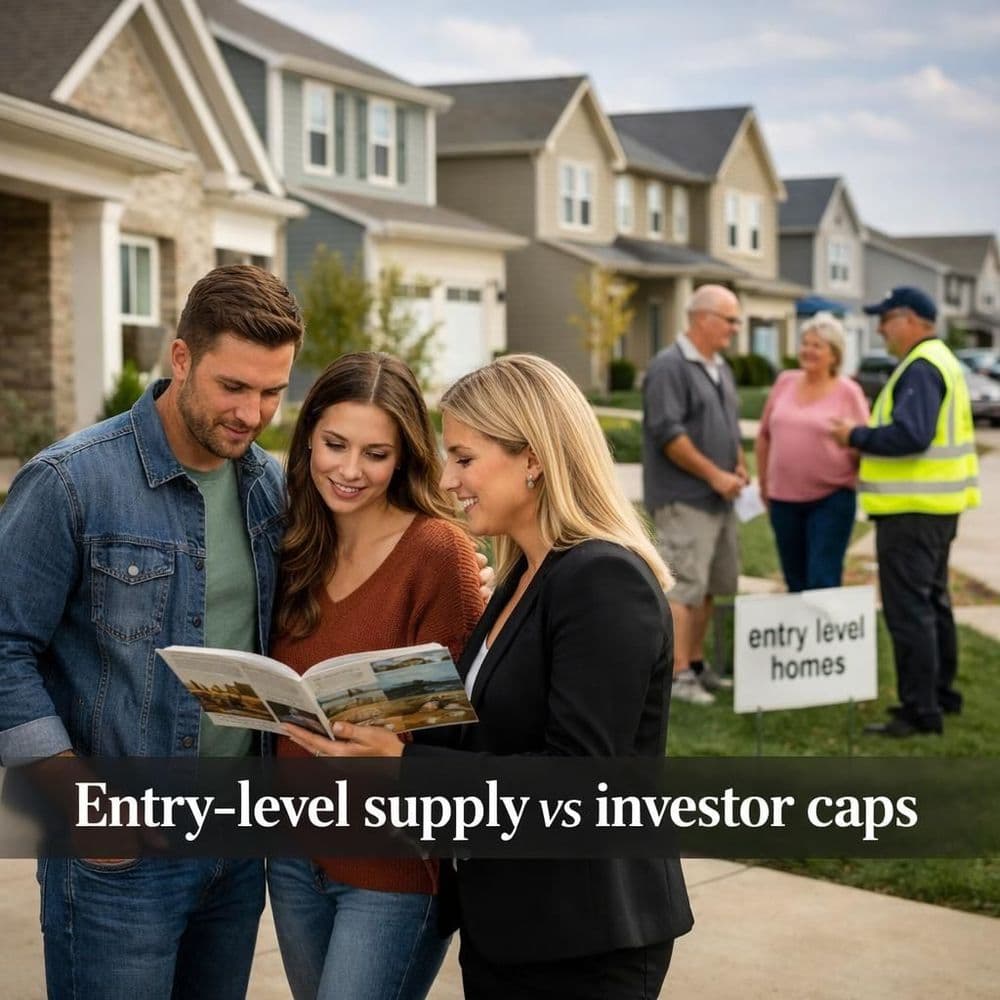
A new entry-level supply pitch is gaining attention
Several large homebuilders are reportedly weighing a plan to deliver up to 1 million new entry-level homes, often branded as “Trump Homes,” aimed at first-time buyers. The core idea is a pathway-to-ownership structure that resembles rent-to-own: renters would make monthly payments for a defined period (one version described as three years) and apply those payments toward a future down payment if they ultimately purchase the home. [realtor.com]
The proposal is described as privately funded by investors, but scaling it nationally could still hinge on the plumbing of U.S. mortgage finance—especially how loans are underwritten and how (or whether) mortgages are guaranteed through the secondary market. Realtor.com notes the concept may require changes to mortgage guarantees offered by Fannie Mae and Freddie Mac to be profitable at scale. [realtor.com]
The central tension is straightforward: the housing market needs more entry-level supply, but a rent-to-own structure can shift risk onto renters if terms are unfavorable or if the home’s value moves against them. Even supportive economists note rent-to-own typically only fits a narrow slice of households—those who can’t qualify today but have a credible path to qualifying in the near future. [realtor.com]
Investor caps are moving from debate to implementation
While some builders look to private capital to finance entry-level inventory, some localities are experimenting with caps designed to limit how many homes in a subdivision become long-term rentals.
Fishers, Indiana’s Home Rental Registration & Permitting Program is a concrete example. The city states the ordinance becomes enforceable on January 1, 2026, requires single-family rental properties (including townhomes and platted condominiums) to register, and limits available permits to less than 10% of long-term rentals per subdivision for newly registered rentals. The city also notes that “legacy” rentals (registered before the effective date) are grandfathered and not counted toward the cap. [wthr.com] [fishersin.gov]
For markets like Fishers—where the city reports high levels of out-of-state ownership and institutional investor ownership among single-family rentals—the policy goal is to prevent neighborhoods from tipping into much higher rental shares and to create an enforcement mechanism (registration) that gives the city better visibility. [fishersin.gov]
The tradeoff is also straightforward: caps can slow investor expansion in a given neighborhood, but they can also constrain rental supply in exactly the areas renters may prefer (good schools, newer housing stock), potentially putting upward pressure on rents elsewhere or pushing demand to nearby communities. The net effect depends on local vacancy, household growth, and how quickly new construction comes online.
Factory-built housing could make “attainable supply” easier to deliver
The third thread is construction method. Modular and other factory-built approaches are being pitched as a way to shorten build timelines and reduce certain costs through repetition, centralized labor, and less weather disruption. In Utah, recent reporting highlighted modular construction as “untapped potential,” with some advocates suggesting cost reductions sometimes cited in the 20%–30% range, depending on the project. [moabtimes.com] [sltrib.com]
Private-sector manufacturers are also trying to push factory-built formats into more product types. Champion Homes has promoted manufactured duplex products as a faster-to-deliver, higher-density option and has pointed to a national housing shortage estimate of about 1.5 million units (citing NAHB). [morningstar.com] [championhomes.com]
None of this eliminates the hard parts—land costs, local approvals, infrastructure capacity, and the reality that “affordable” is ultimately tied to local incomes—but factory-built methods can change the slope of the cost curve, especially for smaller multifamily, supportive housing, or repeatable infill.
What this means if you’re buying, renting, or investing
**If you’re a buyer considering rent-to-own:** Treat it like a financing product, not a housing product. Ask what portion of each payment is credited, what happens if you leave early, who pays for maintenance, and how the future purchase price is set. If the structure requires above-market rent, make sure the tradeoff is clearly worth it relative to saving separately.
**If you’re a renter in a market with rental caps:** Expect the market to segment. Some subdivisions may effectively “close” to new rentals once they hit their cap. That can reduce options in specific neighborhoods even if the metro area still has rental inventory.
**If you’re an investor:** Local registration and permit regimes create compliance risk and liquidity questions (for example, whether a future buyer can continue renting the home). Underwrite for rule changes at the city and HOA level, not just state law.
**If you’re watching supply:** The highest-impact changes are the ones that reliably produce more units: easier approvals, more buildable lots, and faster construction cycles. The question for 2026 is whether the industry can expand entry-level supply without relying on models that keep households renting longer at a premium.
Comments