
Blog
Mortgage rates near 7% are cooling demand—but why home prices keep rising and builders are cutting margins
7 min read
September 24th, 2026
What the latest price data says (and what it doesn’t)
Mortgage rates are doing their job: they’re slowing demand and shifting negotiating power toward buyers. But the recent data also shows that “buyer’s market” conditions don’t automatically translate into falling prices—especially when sellers aren’t under pressure to cut.
Redfin’s Home Price Index shows U.S. prices rising 0.25% from July to August on a seasonally adjusted basis, with year-over-year growth at 3.7%—the fastest pace in a year. Even with momentum easing month to month, prices are still moving higher. [mpamag.com]
Homes.com’s national housing report also points to modest price gains alongside softer activity: the national median home sale price reached $395,000 in August (+2.1% YoY) while sales fell 4.3% and inventory rose 5.4%. The market message is that buyers are still active, but they’re getting choosier about which homes are worth pursuing. [mpamag.com]
Separately, Redfin’s “buyer’s market” framing reinforces a key nuance: having more leverage and more options doesn’t necessarily make homes affordable when rates, taxes, and insurance keep monthly payments high. [nationalmortgageprofessional.com]
Lock-in effect: why resale supply stays constrained
The lock-in effect remains one of the most important explanations for why prices can stay firm even as demand cools. Owners who financed at much lower rates have a built-in reason to stay put rather than trade into today’s higher payment environment.
That dynamic reduces the number of would-be “move-up” sellers and limits resale inventory in many neighborhoods. It also means fewer forced discounts—many owners have equity and can wait, which helps keep a floor under prices even when buyers are cautious. [mpamag.com]
In housing media, the concept is often described as “golden handcuffs”: homeowners with sub-4% mortgages refusing to move unless they have to. [foxnews.com]
Builders feel the squeeze first
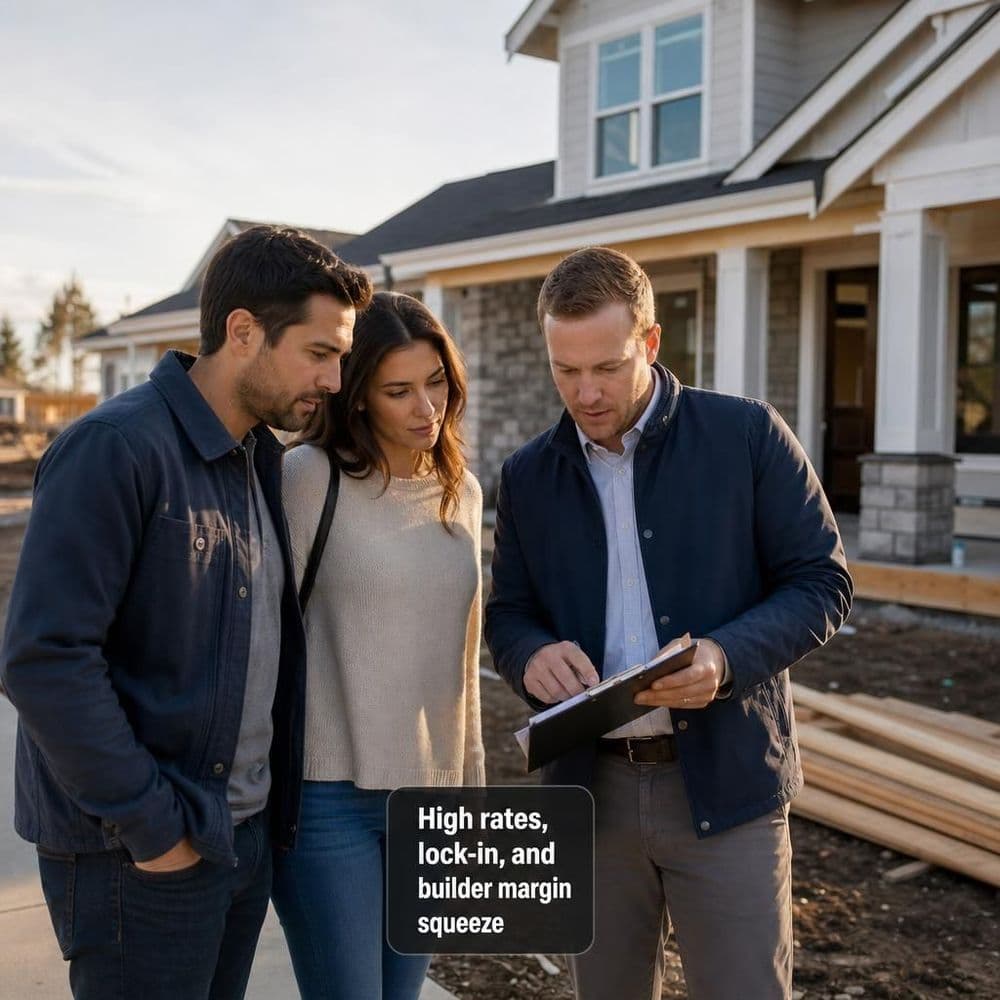
When resale supply is constrained, buyers still need places to live—but higher rates change how they shop. Builders often respond not by slashing sticker prices, but by using incentives (rate buydowns, closing-cost help, design upgrades) to hit a monthly payment target without fully resetting comps. The result: margins take the hit.
KB Home is a recent example. The company cut its annual gross profit margin outlook to 16.0%–16.2% (from 16.1%–16.5%) as conditions weakened. [wsj.com]
Operational results showed the pressure too: KB Home reported fiscal Q3 revenue down 20% year over year to $1.30 billion, with housing gross profit margin down to 16.5% from 18.2% as pricing pressure and higher relative land costs weighed on results. [gurufocus.com]
Public-market performance around housing also reflects rate sensitivity: one report noted Opendoor down 5% while Zillow and Offerpad fell about 3% in a coordinated selloff, alongside a decline in a home-construction ETF—suggesting investors are still treating housing as a “rates first” trade. [247wallst.com]
What to watch next
**1) Rate direction and payment shock.** Rates approaching 7% can push more households to delay purchases, which tends to increase time-on-market and concessions even if prices don’t fall sharply. [fortune.com]
**2) Inventory mix (new vs. existing).** If resale listings remain constrained by lock-in, builders may keep capturing share—but at the cost of incentives and margin pressure.
**3) Regional divergence.** Luxury-leaning or high-income metros can prop up national averages even when many markets soften, so watch local data, not just national prints. [nationalmortgageprofessional.com]
Bottom line: the market can be simultaneously cooler and more buyer-friendly while still posting modest price gains. In this regime, the most visible adjustment often shows up first in builder guidance and margins—long before national home price indexes turn decisively negative. [wsj.com]
Comments