
Blog
U.S. Housing Affordability: Build-to-Rent Limits, Senior Repair Costs, and New Paths Into Housing
6 min read
April 25th, 2026
Build-to-rent policy changes and why supply matters
Build-to-rent (BTR) communities—single-family homes built specifically to be rented—have grown into a meaningful slice of new construction over the past decade. In Houston, the sector has become a large enough part of the pipeline that developers argue changes to investor rules could quickly show up as fewer starts. [houstonchronicle.com]
A key flashpoint is a provision in the 21st Century ROAD to Housing Act that would require large institutional investors to sell single-family home developments to individual buyers within seven years, with renters receiving a first opportunity to buy. Developers and analysts quoted by the Houston Chronicle warn that time-limited ownership can make deals difficult to finance, leading to paused projects and fewer future rentals—an outcome that can push rents up if demand stays steady. [houstonchronicle.com]
Nationally, the Houston Chronicle also cites homebuilding industry analysis indicating BTR grew from under 3% of single-family starts in 2015 to over 5% in 2025, with roughly 68,000 single-family rentals starting construction in 2025. [houstonchronicle.com]
Preserving existing homes: seniors, repairs, insurance, and taxes
Affordability isn’t only about building new units; it’s also about keeping existing housing usable and safe. NBC 5 Dallas-Fort Worth reports that older homeowners are facing rising repair costs, along with increasing insurance and property tax bills—pressures that can turn a paid-off home into an unaffordable one. [nbcdfw.com]
The story highlights that people over 50 are described by advocates as the fastest-growing group facing homelessness, and that Habitat for Humanity reports 19 million older adults live in homes that are in disrepair. Local nonprofit repair programs can prevent displacement, but the piece emphasizes that need is growing faster than funding and staffing. [nbcdfw.com]
This “preservation lane” matters because it can be faster and cheaper than replacing lost units—especially in neighborhoods where rehabs keep long-time residents housed and reduce downstream costs for emergency shelter and healthcare. [nbcdfw.com]
Local “front door” efforts: housing fairs and program navigation
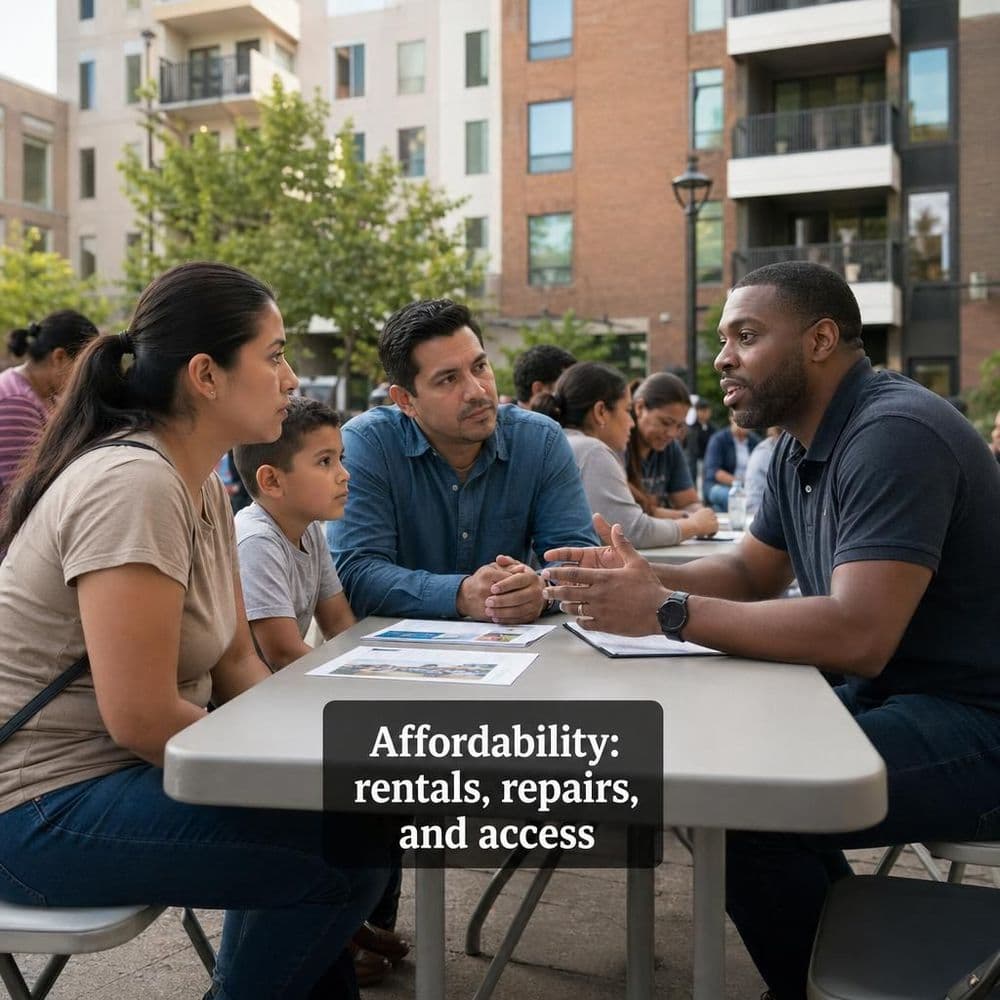
Even when help exists, households often struggle to find the right “entry point.” One approach is the local housing fair model: the Miami Herald reports North Miami is hosting a Fair Housing Fair (April 26, 2026) featuring banks, mortgage lenders, legal experts, and city representatives to answer questions on renting, buying, and protecting a home. [miamiherald.com]
The same article cites Census-based estimates that roughly 45% of Miami-Dade residents rent, and that nearly two-thirds of renters are cost-burdened (spending more than 30% of income on housing), with 36% spending at least half of their paycheck on rent. These kinds of numbers help explain why cities are investing in “navigation” events alongside development programs. [miamiherald.com]
Fractional investing: lower entry costs, new risks
As traditional ownership remains out of reach for many first-time buyers, fractional real estate investing is being marketed as a way to participate in property ownership as an investor. Realtor.com reports that platforms are growing in Sun Belt and Southeast markets, and notes commentary that the affordability crunch is a major catalyst behind the trend. [realtor.com]
Realtor.com also reports that the U.S. Securities and Exchange Commission has clarified rules in recent years that allow broader participation, and cites third-party estimates of more than $2 billion flowing into these platforms in 2025. At the same time, the article includes caution that adding more bidders—even via fractional capital—can worsen affordability in already hypercompetitive submarkets. [realtor.com]
What to watch next
Over the next few quarters, watch three practical signals: (1) whether BTR developers keep pausing projects or pivot toward multifamily in response to uncertainty, (2) whether local repair programs for older homeowners gain stable funding relative to need, and (3) whether newer investment flows meaningfully expand supply—or mostly increase competition for existing homes. [houstonchronicle.com] [nbcdfw.com] [realtor.com]
Comments