
New Affordability Math Shows How Far Prices Must Fall—and Who Can Still Buy in 2026
8 min read
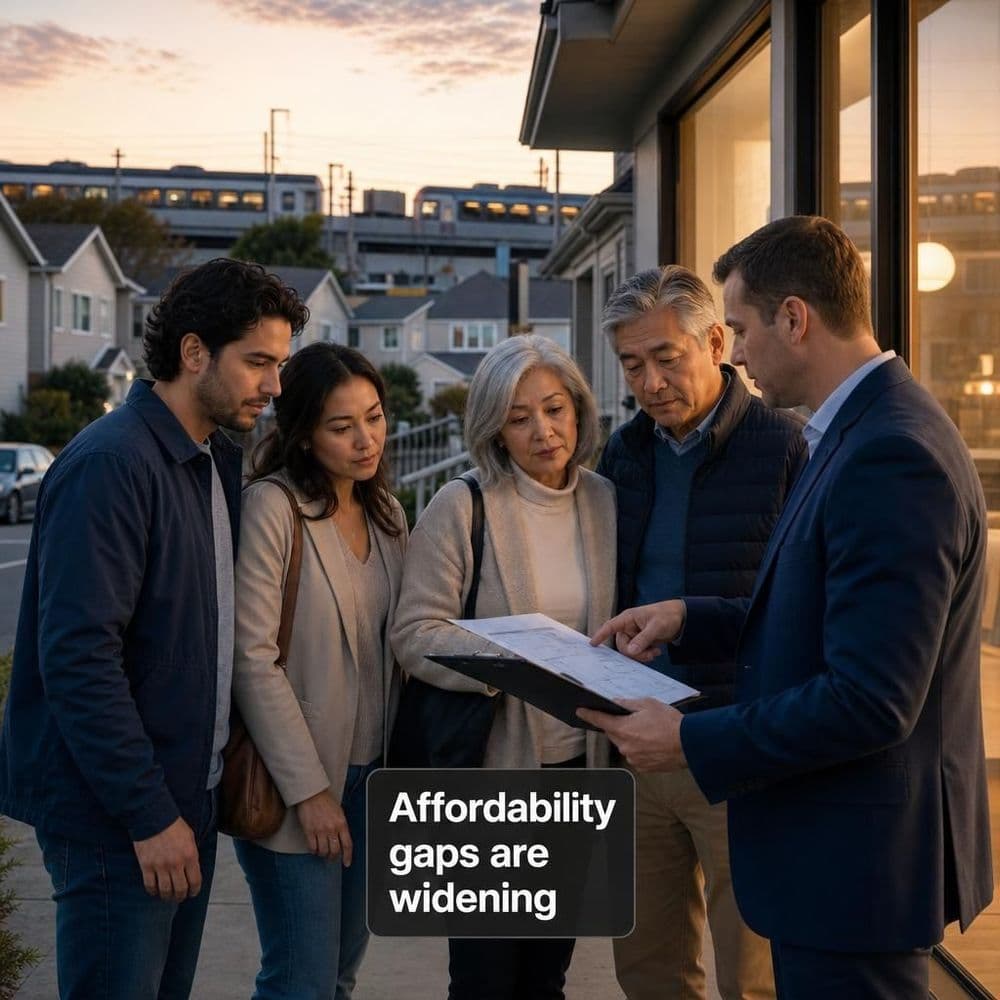
The new baseline: 7% mortgages change the affordability target
A growing share of affordability analysis is now built around a blunt assumption: mortgage rates may not quickly return to ultra-low levels. Using a 7% rate, ConsumerAffairs ran an illustrative budget exercise to show what a median-income household could reasonably afford. Under those assumptions, an ‘affordable’ purchase price lands roughly in the $250,000 to $303,000 range, depending on the down payment. That implies a steep reset relative to a $416,000 starting price—about a 27% to 40% decline. [consumeraffairs.com]
The same piece highlights how dramatically rates compress purchasing power. It estimates the monthly principal-and-interest payment on a $416,000 home with 20% down would rise from about $1,403 at 3% to roughly $2,214 at 7%—before taxes and insurance. To bring that principal-and-interest payment back to about $1,403 while keeping the rate at 7%, the purchase price would need to fall to around $264,000. [consumeraffairs.com]
Separately, Freddie Mac’s Primary Mortgage Market Survey (PMMS) puts the 30-year fixed-rate mortgage at 7.11% as of November 12, 2026—reinforcing why affordability calculators and buyer budgets are being forced to adapt to “7%-ish” financing as a working baseline. [freddiemac.com]
Bay Area reality check: buying vs. renting a single-family home
In the country’s highest-cost metros, affordability challenges show up not only in purchase budgets but also in rents. A Zillow-based analysis cited by the San Francisco Chronicle estimates that buying a typical single-family home in the San Francisco metro requires roughly $307,000 in annual household income. Renting a single-family home isn’t exactly cheap either: the typical October rent of about $4,200 would require about $168,000 in household income. [sfchronicle.com]
The Chronicle also notes the San Jose metro is even more extreme on the ownership side: roughly $405,000 in income to buy, versus about $191,000 to rent the typical single-family home. Zillow’s assumptions include keeping housing costs to 30% of income and making a 20% down payment—an important reminder that methodology matters when comparing metros or time periods. [sfchronicle.com]
Who’s still buying: older, higher-income, repeat buyers
When affordability tightens, the buyer mix tends to shift toward households with more equity, more cash, and more flexibility. Business Insider’s summary of the National Association of Realtors’ latest buyer profile (covering sales from July 2025 through June 2026) shows the median age of all homebuyers at 58, with the most common buyer age range 65–74 (26% of buyers). [businessinsider.com]
The same reporting highlights that the typical buyer’s household income is now well above the nationwide median: it cites a median homebuyer household income of $120,000, compared with a cited nationwide median household income peak of $87,460 in 2025. It also notes that buyers are gravitating back toward the suburbs (48% of purchases), with detached homes dominating (80%). Repeat buyers accounted for 78% of purchases—underscoring how difficult it can be for first-time buyers to compete when rates are high and inventory is limited. [businessinsider.com]
What to watch next
**1) Price flexibility will vary by market.** National affordability math can be useful, but it isn’t destiny. Local taxes, insurance, HOA fees, and household debt loads can swing what’s truly affordable—and those inputs vary dramatically by state and metro. [consumeraffairs.com]
**2) The affordability gap can widen even without a ‘crash.’** If rates stay near 7% and prices only drift down modestly, the market may increasingly cater to older, higher-income repeat buyers—especially in suburban areas where detached inventory matches buyer preferences. [businessinsider.com]
**3) High-cost metros may see more “rent vs. buy” tension.** When the income required to buy pushes into the $300k–$400k range, renting remains the fallback for many households—but single-family rents can still demand very high incomes in places like the Bay Area. [sfchronicle.com]
Bottom line: the latest data points don’t tell one unified affordability story. They show a widening spread between what median-income households can support at today’s rates and what the market still costs in many metros—alongside a buyer pool that is older, wealthier, and more suburban than the typical household. [consumeraffairs.com] [businessinsider.com] [sfchronicle.com] [freddiemac.com]
Comments