
Blog
Housing Pressure Builds for Seniors and Veterans as Aging Demand Outruns Supply
7 min read
May 3rd, 2026
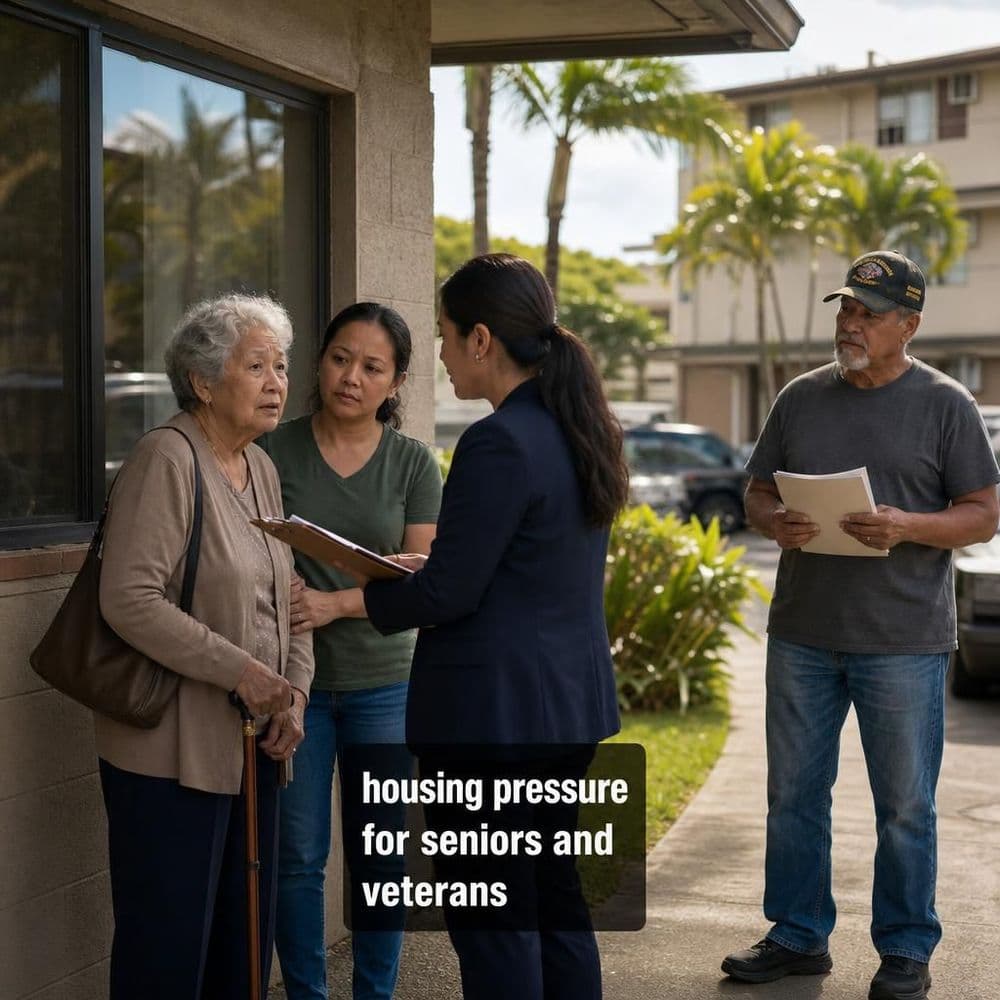
The same affordability problem, showing up in different households
Aging Americans and veterans sit at the center of today’s housing affordability squeeze—not because they’re the only groups under stress, but because they face some of the hardest tradeoffs when costs rise and supply stays tight: fixed or slower-growing incomes, higher health or caregiving needs, and fewer easy options to relocate without losing community ties.
Recent reporting illustrates three connected signals: (1) more demand for age-appropriate housing over the next few decades, (2) a supply pipeline that’s not scaling to match that demand in many markets, and (3) households adapting by “making housing work” through doubling up—often via multigenerational living—rather than finding a new unit at an affordable price. [spectrumlocalnews.com] [people.com]
Why aging demand is becoming a supply issue
Housing for older adults isn’t a separate universe from the broader market. When the supply of smaller, accessible, lower-maintenance homes is limited, older homeowners may delay downsizing, and older renters face fewer affordable choices—pushing competition into the same pool of units that working families are trying to access.
That mismatch can show up as:
- Higher rent burdens among older renters
- Longer “tenure” in existing homes due to lack of viable alternatives
- More remodeling/retrofits to support aging in place
- Increased reliance on family living arrangements
Some of these outcomes are positive (e.g., families supporting each other). But at scale they also highlight a system constraint: if the market doesn’t offer enough attainable, accessible units, households will use informal workarounds instead. [people.com]
Hawaiʻi as a case study: an explicit unit target for 2050
One of the clearest data points in the current coverage comes from Hawaiʻi. Local reporting on an AARP Hawaiʻi-backed analysis says the state will need roughly 60,000 additional housing units by 2050—and that residents age 65+ will need a large share of those units. [spectrumlocalnews.com]
What makes estimates like this useful isn’t just the headline number. It’s that they force a practical question: if a state needs tens of thousands of additional homes over a specific timeframe, what’s the realistic annual production pace—after accounting for permitting, labor, infrastructure, financing, and community constraints?
When the implied “build rate” is far above recent experience, the result is usually a widening gap that expresses itself through higher rents, more overcrowding, and greater housing instability among households least able to absorb shocks. [spectrumlocalnews.com]
Veterans: when support tightens in a tight-inventory market
Veterans using VA-backed mortgages have historically benefited from underwriting features designed to expand access to homeownership. But in a market where home prices and payments remain high, even small disruptions—income shocks, escrow increases, or resets after temporary relief—can translate into missed payments.
A Newsweek report describes veterans facing a housing squeeze as some VA assistance is pulled back and as promised housing plans move slowly, alongside signals of growing distress for some VA borrowers. [newsweek.com]
The broader market context matters: when inventory is scarce and replacement housing is expensive, households under stress have fewer “soft landing” options (sell and downsize, rent nearby, move to a comparable home). Tight supply can turn a manageable hardship into a forced move. [newsweek.com]
Multigenerational living: a rational response to affordability and caregiving
A People.com profile on a multigenerational household underscores why more families are choosing to share a home: it can reduce per-person housing costs, enable caregiving, and create stability amid rising rents and home prices. [people.com]
From a housing-market perspective, multigenerational living can be both:
- **A resilience strategy** for households
- **A symptom** of insufficient affordable supply
For communities, one of the policy-relevant questions is whether the housing stock can adapt to this reality: accessory dwelling units (ADUs), duplex/triplex conversions where allowed, and retrofits that improve accessibility and privacy. Even when zoning allows it, the economics can be challenging—construction costs, financing, and permitting timelines can all be barriers. [people.com]
Practical takeaways: what to watch next
Here are a few indicators that can help readers track whether the “aging demand vs. supply” problem is improving or worsening:
- **Production of smaller, accessible units:** not just total starts, but the types of homes being delivered.
- **Rental affordability for 55+ and 65+ households:** rent growth relative to fixed incomes.
- **Servicing/relief transitions for VA borrowers:** whether off-ramps from temporary assistance are smooth or cliff-like. [newsweek.com]
- **Permitting and ADU activity:** whether local rules and timelines allow households to add flexible space.
The throughline in the current reporting is simple: the country doesn’t just need “more housing.” It needs more of the *right* housing—attainable, accessible, and located near healthcare, transit, and family networks—before demographic demand turns today’s affordability strain into tomorrow’s displacement wave. [spectrumlocalnews.com] [newsweek.com] [people.com]
Comments