
Blog
Housing Starts Slump in May: What Builder Incentives and 3D-Printed Homes Signal for Affordability
7 min read
June 17th, 2026
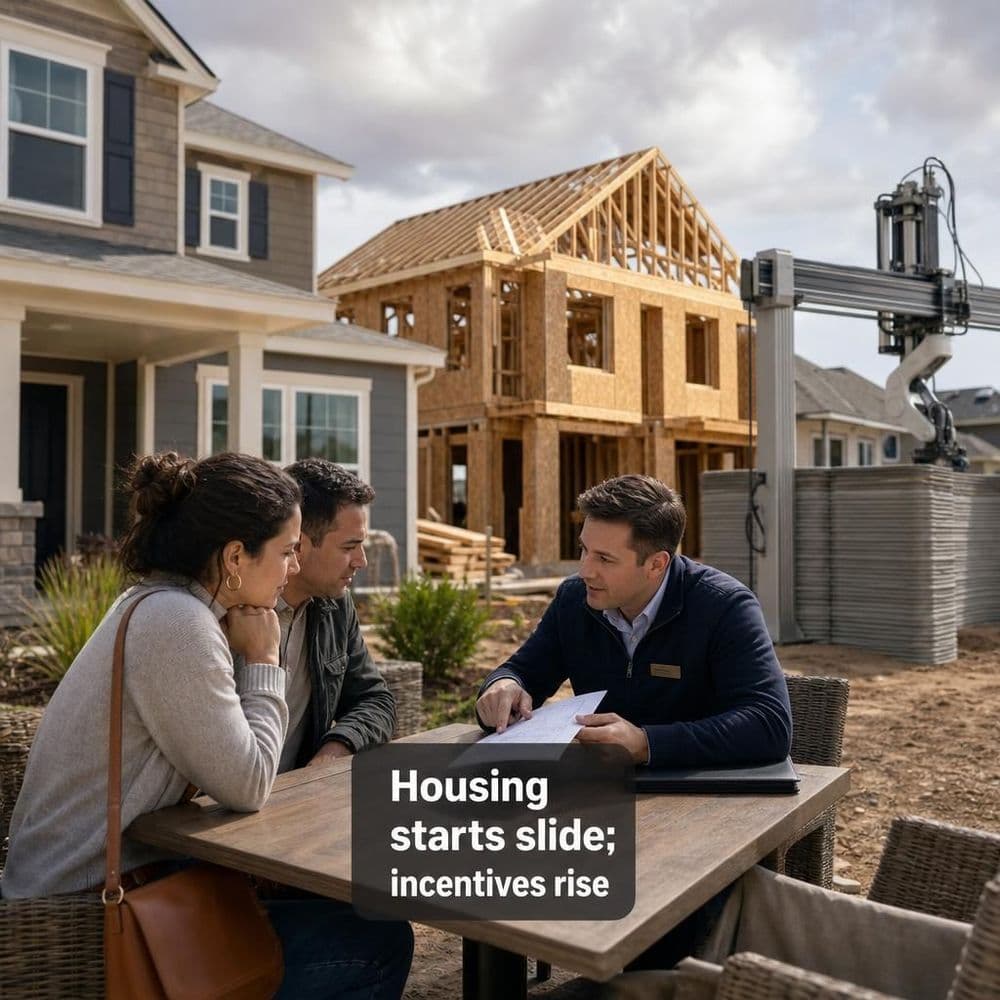
The May starts drop: what moved, and what didn’t
May’s housing-starts report delivered a headline-grabbing decline: total starts fell 15.4% from April and 8.7% from a year earlier, largely because multifamily construction pulled back sharply. Realtor.com reports that single-family starts were at a seasonally adjusted annual rate of 882,000, down 1.9% month over month and 6.7% year over year, while starts for buildings with five units or more fell steeply. [realtor.com]
That mix matters. Multifamily can swing more from month to month, and a big move there can dominate the total number even if single-family doesn’t collapse. RealEstateNews.com similarly framed May as a correction after stronger spring readings, while still noting softness in the single-family pipeline. [realestatenews.com]
Builder sentiment stays weak—so incentives do the heavy lifting
With affordability tight and mortgage rates elevated, builders are leaning heavily on concessions to keep payments workable. The NAR write-up highlights common playbooks—mortgage-rate buydowns, closing-cost assistance, and price reductions—showing up broadly across new-home sales strategies. [nar.realtor]
The NAHB/Wells Fargo Housing Market Index (HMI) remains subdued. In June, NAHB reported that 35% of builders cut prices (up from 32% in May), the average price reduction was 6%, and 62% of builders used sales incentives—marking the 15th consecutive month with incentives at 60% or higher. [nahb.org]
For a concrete example of how aggressive incentives can get, Fast Company reports Lennar spent an average of 12.9% of final sales price on incentives in Q2 2026, with ResiClub estimating typical incentive spending around $54,947 per home. [fastcompany.com]
Permits, completions, and why the pipeline matters
Starts grab attention, but permits and completions tell you how builders are positioning for what comes next. Realtor.com notes total permits were at a seasonally adjusted annual rate of 1.413 million in May, only slightly below April and roughly flat year over year. That suggests builders may be cautious, but not uniformly slamming on the brakes. [realtor.com]
Still, other pipeline metrics point to restraint. RealEstateNews.com reported single-family permits down 1.8% year over year, homes currently under construction down 7.1%, and completions down 16.8% over the same period. [realestatenews.com]
One caveat: month-to-month swings can be noisy. Even Realtor.com quoted economists suggesting timing effects may be shifting activity between months, which is why it’s worth watching whether June data rebounds. [realtor.com]
Alternative construction enters the financing conversation
Even with incentives, the industry’s bigger affordability problem is still about delivering more homes at lower all-in costs. That’s where alternative construction methods keep popping up in the conversation.
National Mortgage Professional reports Wells Fargo became a preferred mortgage lender for ICON-built 3D-printed homes and will offer qualified buyers a 50-basis-point lender credit. The stated goal is to expand access to financing for 3D-printed housing while supporting broader affordability and supply efforts. [nationalmortgageprofessional.com]
This matters because construction innovation often stalls at the financing step: if appraisals, underwriting, and resale comps are unclear, adoption slows. Preferred-lender programs and standardized incentives are one way to reduce friction—though the overall footprint of 3D-printed homes remains small today. [nationalmortgageprofessional.com]
Affordability context: starter homes aren’t ‘starter’ in many cities
Affordability pressure is increasingly visible at the entry level. Zillow reports a record 242 U.S. cities now have a “typical starter home” valued at $1 million or more, up from 80 in February 2020. Zillow also puts the typical starter-home value nationwide at $198,649, up 1.7% from a year ago. [investors.zillowgroup.com]
The practical takeaway: even if builders can keep new-home demand alive with incentives, the broader path to durable affordability still runs through supply—especially in regions where new construction lags and inventory deficits remain persistent. [investors.zillowgroup.com]
What to watch next
Over the next few months, keep an eye on whether permits stabilize or slip further, whether incentive intensity rises again (which can support sales but pressure margins), and whether alternative construction financing expands beyond pilot-style programs into repeatable products. [nahb.org][nationalmortgageprofessional.com]
Comments