
Blog
Local affordability experiments: land trusts, city-backed subdivisions, and denser homes widen access to ownership
7 min read
June 1st, 2026
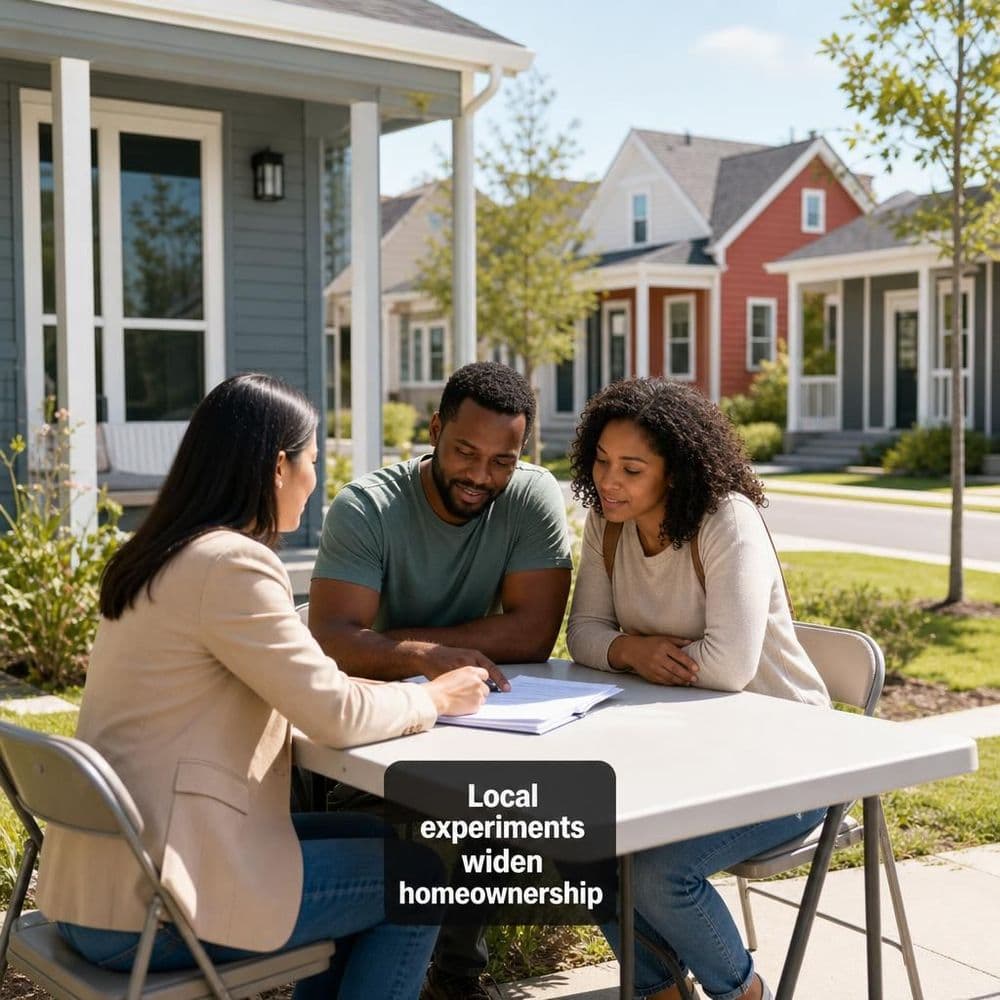
Why the affordability conversation is shifting local
Even as national home prices remain elevated in many regions, some of the most practical movement on affordability is happening city by city. Local governments, nonprofits, builders, and community groups are testing targeted approaches aimed at either (a) reducing the upfront cost to buy or (b) preserving affordability for the next buyer—not just the first one.
The current wave of initiatives tends to share a common premise: if you can’t count on a broad price correction, you can still create a smaller pool of homes with a lower entry price (and sometimes long-term price controls) through local design changes, land strategies, or program rules.
Supply-side experiments: smaller homes and more density-friendly formats
One set of solutions focuses on changing the “starter home” itself. Instead of only building large-lot single-family, some communities and builders are leaning into more compact formats—sometimes described as missing-middle housing—that can land at a lower price point because they use less land per home and can be built more efficiently. Coverage from Colorado highlights how density discussions aren’t limited to apartments; new single-family-adjacent styles can create more attainable options while still feeling residential. [gazette.com]
These formats aren’t magic. Where land and labor are expensive, smaller designs may still be out of reach for many households. And local zoning, infrastructure capacity, and neighborhood acceptance can limit where these homes get built. But when they scale, they can add meaningfully to entry-level inventory in a way that’s hard to replicate with one-off subsidy programs.
Long-term affordability models: community land trusts and shared equity
Another track is structural: community land trusts (CLTs) and other shared-equity models designed to keep homes affordable over multiple resale cycles. In a typical CLT structure, a buyer purchases the home, while the land is held in trust (or under a long-term ground lease). Resale rules often cap appreciation to preserve affordability for the next buyer—meaning the home can remain “below market” even if surrounding prices rise.
A local example in Webster Groves, Missouri describes a land trust approach that aims to preserve smaller homes and offset high prices one property at a time. That “one house at a time” framing is a strength and a weakness: it can be durable, but scaling requires steady capital, staffing, and a pipeline of homes that can fit the model. [stltoday.com]
For buyers, the tradeoff is important to understand. Shared-equity programs can reduce the upfront purchase price and stabilize ownership costs, but they typically limit future resale gains. That can still be a net positive—especially for households otherwise stuck renting—but it’s not the same wealth-building profile as an unrestricted-market home.
A case study in volume: Austin’s recent affordability shift
Some markets have seen affordability improve not through restricted-resale programs, but through a surge in building and listings that shifts the supply-demand balance. Barron’s points to Austin as a notable example: policy and market conditions helped set up a construction boom, and the result has been lower home prices and higher sales activity compared with the prior peak. [barrons.com]
Austin’s experience doesn’t automatically translate to every metro. Different regions face different constraints: land availability, permitting timelines, labor supply, and the share of demand coming from in-migration or investors. Still, the lesson is useful: when a market can actually deliver enough homes at enough pace, pricing pressure can ease—sometimes faster than skeptics expect.
What buyers and investors should look for locally
If you’re shopping in a high-cost area, it’s worth mapping the “parallel market” that exists alongside typical listings:
- **Land trust / shared-equity homes:** Ask for the ground-lease terms, resale formula, income limits (if any), and lender requirements. Make sure you understand how appreciation is capped and what happens if you want to rent the property out.
- **Municipal or nonprofit affordable subdivisions:** These programs can reduce the all-in price, but may include occupancy rules, buyer education requirements, or resale restrictions. A recent ribbon-cutting in Orland Park Estates highlights how some programs pair affordability with sweat-equity or participation requirements. [actionnewsnow.com]
- **Compact new-build options:** If your market is adding smaller-lot or missing-middle homes, compare HOA costs, parking/storage tradeoffs, and long-term resale demand.
Bottom line
Local affordability experiments won’t solve the national housing shortage by themselves. But they do offer something many households need right now: a realistic path to ownership in specific neighborhoods, with clearer price points and (in some cases) protection against future price spikes. The practical opportunity is local—so the smartest next step is to learn what models exist in your county and what rules come with them.
Comments