
Blog
Diverging Home Price Paths: Why Some U.S. Markets Are Still Climbing While Others Cool
6 min read
May 15th, 2026
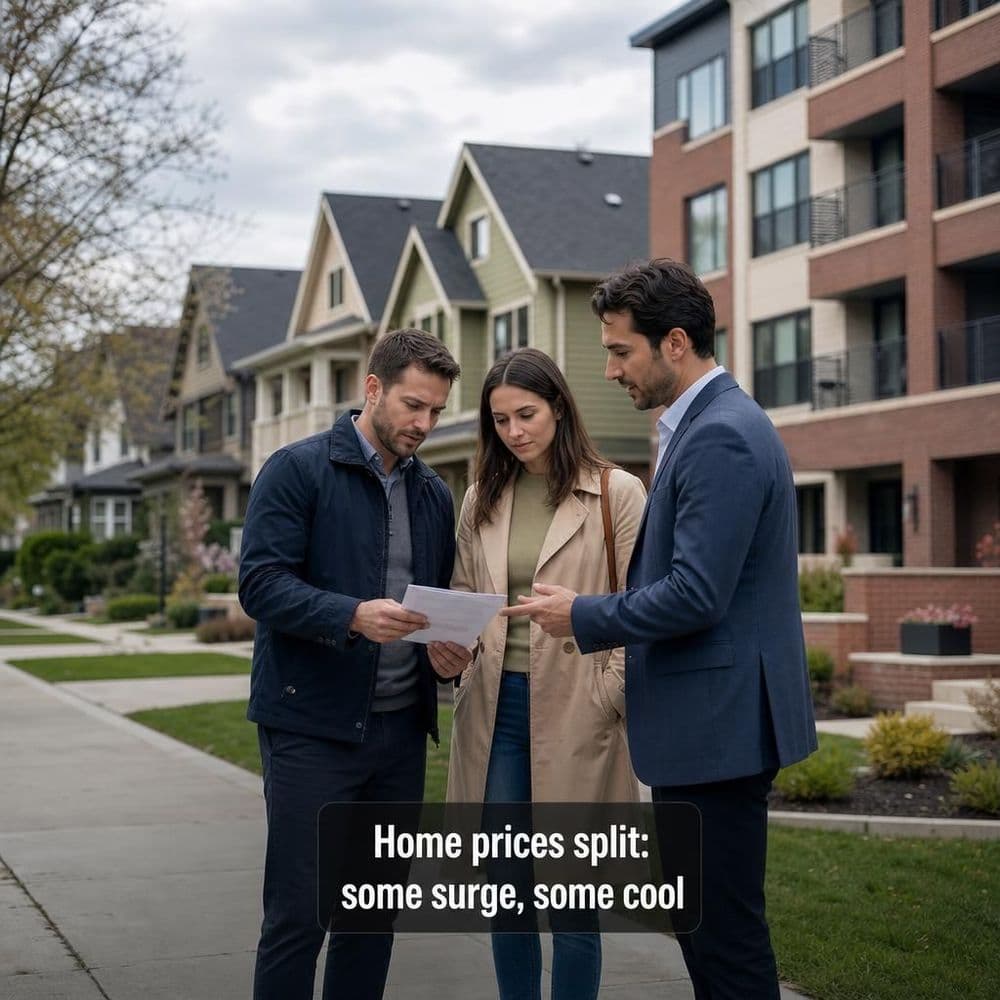
The national backdrop: modest price gains, less seller power
The clearest signal right now is that the national market can be “up” overall while still feeling very different from one metro to the next. Redfin’s April reporting shows the median U.S. home sale price rose 2.4% year over year, a notable acceleration versus much of 2025, but not a return to the frenzied conditions of early 2022. [redfin.com]
One detail that captures the new balance of power: even with prices rising, a majority of homes are still selling for less than their initial asking price. Redfin’s April data shows 60.5% of homes sold below the initial list price. That’s a big reminder that many sellers are still negotiating, even if price cuts have been easing recently. [thestreet.com]
At the same time, borrowing costs remain a key constraint on demand. Freddie Mac’s weekly survey put the average 30-year fixed rate at 6.36% as of May 14, 2026. [globenewswire.com]
Where prices and speed are still holding up
“Hot” in 2026 often looks less like runaway price growth and more like homes selling quickly with fewer compromises from sellers. One proxy is time on market. A recent ranking cited Allentown as the No. 7 fastest-selling market among the 100 largest U.S. metros, with homes spending a median of 28 days on market; 44% were off the market within two weeks. [lvb.com]
In the Southeast, local coverage highlighted that Columbia, South Carolina continued to post year-over-year gains even as many cities cooled. A SmartAsset analysis using the Zillow Home Value Index showed Columbia’s typical home value rising from $224,143 in 2025 to $226,769 in 2026 (about +1.17%). [thestate.com]
These kinds of markets tend to share a few traits: limited entry-level inventory, steady household formation, and a buyer pool that’s still deep enough to absorb new listings without forcing widespread price cuts.
Where the market is cooling—and what that changes
In cooling markets, the “story” isn’t always a dramatic price drop—it’s the shift in leverage. That can show up as longer days on market, more listings with price reductions, and more frequent appraisal or financing friction.
San Antonio stands out as a case where price and valuation softness is spilling into local fiscal math. Realtor.com reported taxable values on existing properties in San Antonio were down 3.5%, with overall taxable value (including new properties) down 2.1%, contributing to a local budget gap. [realtor.com]
In Midland, Michigan, local reporting points to a more balanced feel than in recent years: inventory has improved, patience matters more, and buyers are being encouraged not to stretch beyond their budget just to win. [ourmidland.com]
How to read your local market in 5 metrics
If you’re trying to gauge whether your metro is in the “still climbing” bucket or the “cooling” bucket, focus on a handful of practical, comparable indicators:
- **Days on market**: Are homes going pending quickly (weeks) or sitting (months)?
- **Share of listings with price drops**: A rising share usually signals a buyer-friendlier turn.
- **Sale-to-list and under-asking share**: Redfin’s under-asking share is a useful benchmark for negotiation conditions. [thestreet.com]
- **New listings vs. active inventory**: More new listings without matching demand can soften prices.
- **Local buyer mix**: In some metros, in-state moves or equity-rich relocations can change the competitive set for locals.
The bottom line: national averages are helpful context, but 2026 is increasingly a “zip-code market.” The most important question is whether your local inventory is truly tight relative to qualified buyers at today’s mortgage rates. [globenewswire.com]
Comments