
Blog
From modular infill to rate buydowns: how affordability pilots are targeting the real cost drivers
6 min read
August 7th, 2026
Why ‘cheaper to build’ isn’t the whole story
A lot of housing “innovation” marketing focuses on materials and speed. But the pilots popping up in different corners of the country suggest the bigger question is: *what portion of the total delivered cost is actually being reduced—and for whom?*
A Spectrum News report on new-home construction costs highlighted that required permits and fees alone can add more than $132,000 to a new home’s cost, even before you talk about lumber, concrete, or labor [spectrumlocalnews.com]. That’s a useful backdrop for evaluating new building methods: if the soft-cost stack stays the same, a faster shell doesn’t automatically translate into a dramatically cheaper home.
Modular homes on public lots: reducing land friction
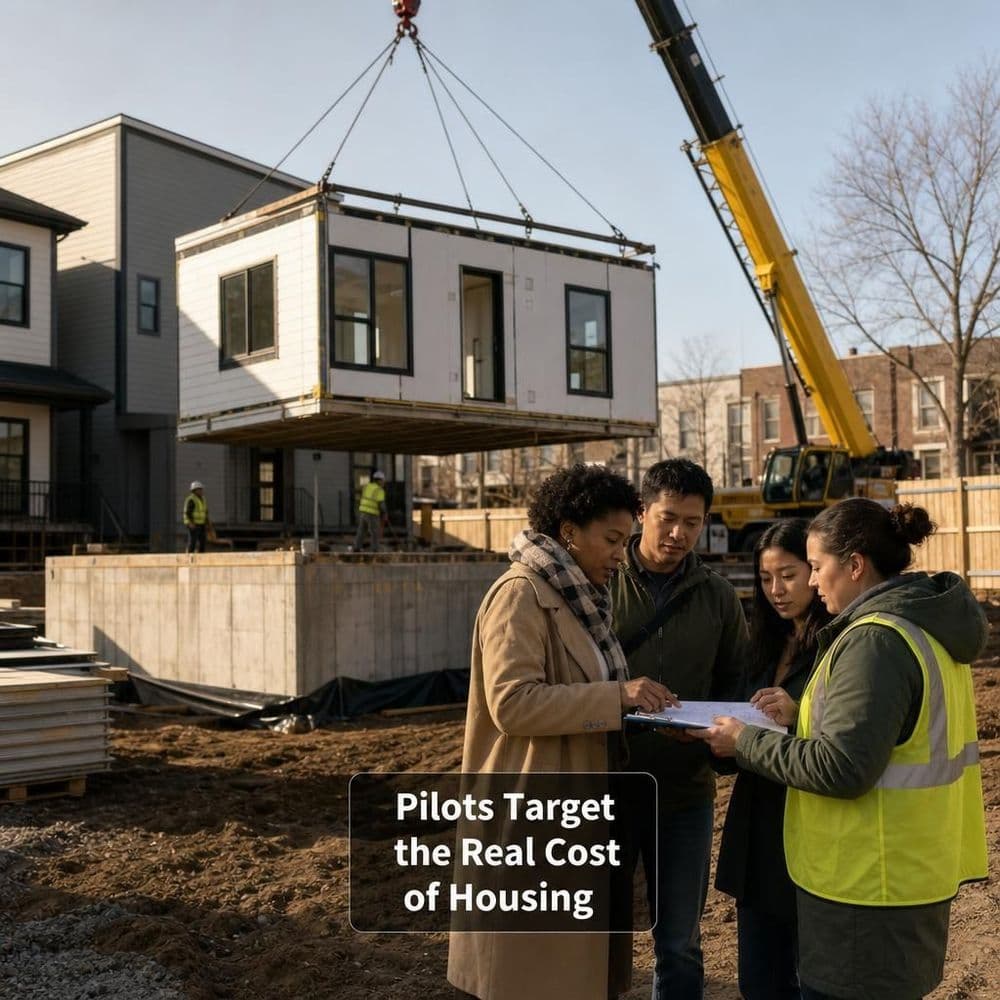
Covington, Kentucky is testing a straightforward idea: combine city-owned vacant lots with modular construction to speed delivery and reduce land acquisition cost. In coverage of the city’s Pleasant Street project, the first modular homes were installed after being built off-site in Vandalia, Ohio, with local officials citing factory build times of roughly three to four months versus about six months for traditional construction [local12.com].
The homes are expected to sell for around $250,000, while costing roughly $300,000 each to build—implying a gap that must be covered by some combination of land contribution, subsidy, or program structure [local12.com]. The city also said the finished homes won’t be sold to investors or non-occupants, a guardrail meant to preserve the homeownership intent of the pilot [local12.com].
Mutual self-help construction: sweat equity as a subsidy
In Heber City, Utah, Mountainlands Community Housing Trust is using a “mutual self-help” approach: households build together, contributing 30 hours of construction work per week, including at least 15 hours from the future homeowner [kpcw.org]. The nonprofit planned an Aug. 11 unveiling for six new townhomes at its Parkview Place project, a subdivision with 49 lots that began construction in 2017 [kpcw.org].
This model can reduce labor costs and deepen buy-in, but it also has practical constraints: families must have the time capacity to contribute, and (per the reporting) applicants must secure their own financing and show proof before breaking ground [kpcw.org].
Financing pilots: permanent rate buydowns for new builds
Not every affordability experiment changes the build method. Housing New Mexico launched “NewHome Rate Advantage,” a pilot permanent 1% interest-rate buydown on a fixed-rate 30-year first mortgage for qualified buyers purchasing a newly constructed home through the agency’s HomeForward program [losalamosreporter.com].
The agency’s example estimate: on a $300,000 loan, the 1% buydown could save about $188 per month [losalamosreporter.com]. The pilot has limited funding and is expected to help roughly 350 to 400 households, and it’s restricted to owner-occupants (not investors, rentals, or second homes) [losalamosreporter.com].
A key takeaway is that “affordability” can mean monthly payment relief even when all-in construction costs remain high—especially in markets where new homes are close in price to existing homes, as builders told Spectrum News [spectrumlocalnews.com].
Apartment supply still matters
While many pilots focus on for-sale homes, Orange County, Florida’s newsroom reported that four affordable apartment communities supported by its Affordable Housing Trust Fund opened since April 2026, adding 542 apartment homes [newsroom.ocfl.net]. The same update cited cost-burden statistics for the Orlando-Kissimmee-Sanford metro area (61% of renters and 40% of households cost-burdened) as context for why production is being prioritized [newsroom.ocfl.net].
What to watch next
Across these examples, the “innovation” is less about a single technology and more about a bundle of choices:
- **Speed to occupancy:** How quickly do modular and self-help approaches convert a vacant lot into a certificate-of-occupancy-ready home?
- **All-in cost after site work:** Site prep, utility hookups, and fees can erode savings if not addressed alongside the build method.
- **Eligibility and guardrails:** Owner-occupant rules and income/price limits shape who benefits and whether pilots translate into long-term affordability.
The next data points that will matter most are the final delivered costs, the time from financing approval to move-in, and whether these approaches can scale without losing the affordability they’re designed to create.
Comments