
Blog
Mortgage rates near 7% are cooling demand — and giving buyers leverage again
6 min read
September 19th, 2026
A market that’s moving slower — and feeling different
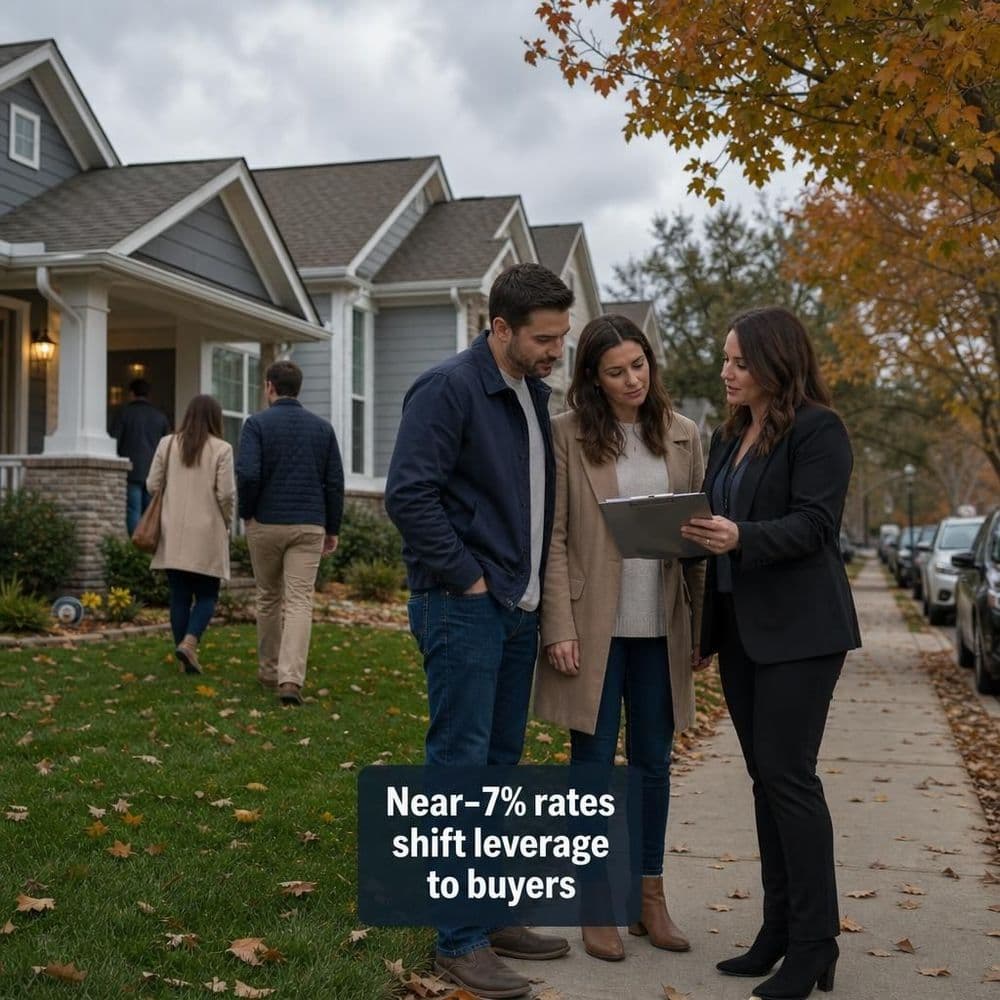
Mortgage rates near 7% are changing the tone of the U.S. housing market. The impact isn’t uniform, but the common thread is the same: higher monthly payments are thinning the buyer pool, which gradually shifts negotiating power back toward buyers.
What the latest national data says
Pending home sales — a measure of contract signings that typically lead closings by about a month or two — rose just 0.3% in August 2026 but were down 4.7% from a year earlier, according to the National Association of REALTORS® [nar.realtor]. That “flat-to-down” pattern is consistent with a market where households are still price-sensitive and payment-constrained, even if some buyers are returning as inventories improve.
One reason pending sales are so useful is that they capture decision-making at the moment buyers and sellers agree on terms. When rates rise quickly, that agreement becomes harder to reach without a price cut, a seller credit, or an incentive that reduces the payment.
Builders are adapting: incentives and slower deliveries
New-home builders have been more flexible than many resale sellers because they can adjust incentives quickly while trying to protect headline prices. In recent months, rate buydowns have become a major tool for keeping monthly payments in reach; HousingWire reports buydowns are supporting roughly 80–90% of new-home sales [housingwire.com].
At the same time, builders are watching demand closely and adjusting output. Lennar cut its full-year home delivery target to 80,000–81,000 homes (down from 82,000–83,000 previously) and cited interest-rate pressure and worsening market conditions [wsj.com].
Construction data also signals a more cautious stance. U.S. housing starts fell 2.6% in August to a 1.275 million annual pace, while permits fell 2.7% to 1.394 million, per a Commerce Department report summarized by The Wall Street Journal [wsj.com]. Even where single-family starts hold up, a weaker pipeline can mean fewer completed homes hitting the market later — especially if builders keep pulling back when buyer traffic slows.
Inventory and pricing: where buyers are gaining power
Where inventory has built the most, the shift is becoming visible to everyday shoppers. In Texas, the Texas Real Estate Research Center reported statewide sales up 2.2% year over year in July 2026, but also noted active inventory around 156,000 listings at July month-end (up 2.2% from June) and a 5.5-month supply statewide [trerc.tamu.edu]. In other words: activity is still happening, but buyers have meaningfully more choices than during the tightest years.
Some metros are moving faster toward buyer-friendly conditions. In the Raleigh/Durham Triangle, ABC11 reported a “rare buyer’s market,” describing a growing surplus of homes for sale and sellers turning to price reductions and extra marketing to draw offers [abc11.com].
This is how leverage tends to show up first:
- **More price reductions** (or fewer bidding wars)
- **Longer time to get an acceptable offer**
- **Concessions** like closing-cost credits, repair allowances, or rate buydowns
What buyers and sellers can do next
**If you’re buying:**
- Treat the monthly payment as the real price. Compare a lower purchase price vs. a seller credit that funds a rate buydown.
- Use the slower pace to be more selective on inspection and appraisal risk.
- In new construction, ask what incentives are already baked into the community’s current pricing and what’s negotiable (rate buydown, upgrades, closing costs).
**If you’re selling:**
- Price to today’s payment reality, not last spring’s comps.
- Expect buyers to negotiate repairs and credits more often.
- If showings are slow, a quick, decisive price correction can beat “chasing the market” with small reductions.
**What to watch:**
- Weekly mortgage-rate moves and how quickly they change buyer traffic
- Pending sales as a forward-looking signal for closings
- Starts and permits for the future supply pipeline
Bottom line: with rates near 7%, the market is increasingly splitting into “must-sell / must-buy” transactions and everyone else waiting for better payment math. That’s a recipe for slower sales — and more leverage for the buyers who stay in the game.
Comments