
Blog
Housing Shrinkflation: Why New Single-Family Homes Are Smaller Even as Costs Stay High
7 min read
August 29th, 2026
What the latest size data says
New-home square footage has been drifting lower for years as affordability tightened, with a brief pandemic-era reversal when rates were unusually low. NAHB’s Eye On Housing, citing Census data and NAHB analysis, reported that in 2026 Q2 the median new single-family home was about 2,185 square feet and the mean was about 2,426 square feet, with the moving-average series showing a slight uptick as higher-end demand has held up better than entry-level demand. [eyeonhousing.org]
That recent “small gain” doesn’t erase the bigger arc: many builders have been forced to rethink how much home they can deliver at a price point buyers can actually finance.
The price-per-square-foot problem
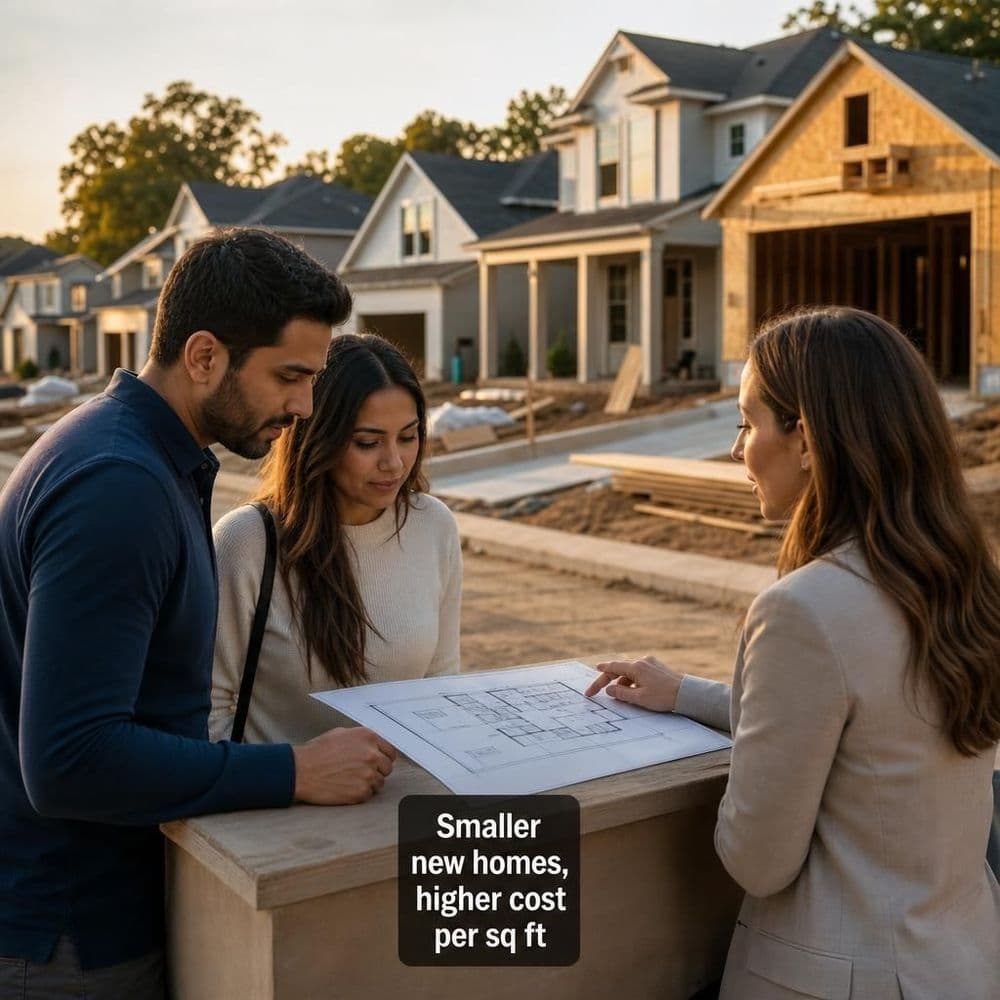
Even when total prices stabilize, buyers can still feel squeezed if each square foot costs more. A LendingTree analysis of Census Bureau new-home sales data found the average size of new single-family homes sold fell 11.6% from 2,724 sq ft (2015) to 2,409 sq ft (2025), while the average price per square foot rose 71.9% from $100.02 to $171.95 over the same period. [lendingtree.com]
In plain terms: smaller homes can lower the headline price and the monthly payment, but the “bang for your buck” per square foot has worsened.
How builders are adjusting product mix
Some of the change is straightforward downsizing. LendingTree found that 25% of new single-family homes sold in 2025 were under 1,800 sq ft (up from 16% in 2015), while the share of 3,000+ sq ft homes fell from 33% to 20%. [lendingtree.com]
Separate market-tracking suggests the mix shift is colliding with softer demand. HousingWire, citing Census new-home sales data, noted that builders have leaned on incentives and that product mix matters: a larger share of sales has been under $400,000, alongside commentary that builders are constructing and selling smaller, lower-priced homes to fit budgets. [housingwire.com]
Meanwhile, Realtor.com’s 2026 Q2 new-construction report shows a nuance worth watching: the median for-sale newly built home was roughly flat-to-slightly higher year over year (about 2,050 sq ft) and the median price per square foot for new homes slipped a bit (to about $217 from $219). That’s a reminder that “shrinking” can differ depending on whether you’re looking at homes sold, homes listed for sale, or a specific price tier. [realtor.com]
What this means for buyers and investors
For buyers, the key is to separate total payment from unit cost. A smaller floor plan can reduce the down payment, insurance, and utilities, and can be easier to maintain — but if you pay a high price per square foot, you may be locking in expensive space.
For investors, shrinking new homes can alter competition with existing homes. If new builds are increasingly suburban and standardized, they may compete more on incentives and payment buydowns than on raw size. At the same time, a smaller footprint can mean lower ongoing operating costs and potentially broader renter demand at certain price points.
The big picture: the U.S. is recalibrating what “attainable” new construction looks like. Size is one of the few levers builders can pull quickly — but the data suggests that trimming square footage doesn’t automatically solve affordability when the cost per square foot has risen so much.
Comments