
Blog
States and cities crack down on illegal rent hikes, rent caps, and fee workarounds
7 min read
January 16th, 2026
What’s changing: enforcement, not just rules
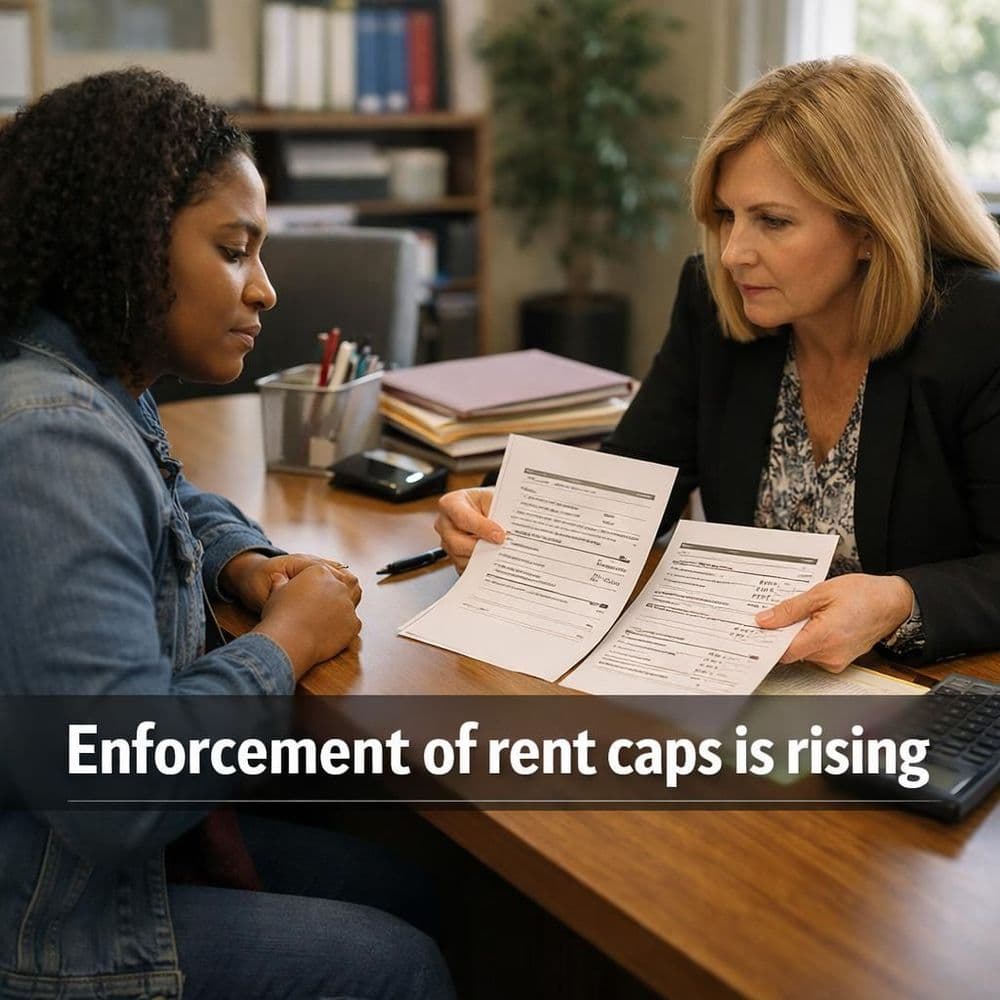
A growing number of jurisdictions are moving from passing tenant-protection rules to actively enforcing them. The practical shift is that “noncompliant rent growth” is increasingly being treated as an enforceable overcharge—triggering withdrawn notices, refunds, and settlement terms that restrict future pricing behavior.
Washington: first enforcement actions under a rent cap law
On August 6, 2025, Washington’s Attorney General announced the first enforcement action under the state’s rent stabilization law (HB 1217). The office entered into eight resolutions with landlords across the state; the landlords agreed to withdraw rent-increase notices and refund any excess rent tenants had already paid. The resolutions were filed in multiple county superior courts. [washingtonstatestandard.com]
For operators, the lesson is that compliance isn’t just about the percentage increase—process (notice language, effective dates, and documentation) matters too when a state is willing to file court resolutions. [washingtonstatestandard.com]
Algorithmic rent-setting: new constraints on data and coordination
A parallel front of enforcement is targeting how rents get set in the first place—especially where software recommendations may rely on competitors’ nonpublic information. In late 2025, reporting on the RealPage settlement described limits that restrict the use of real-time data in pricing recommendations and require that any nonpublic training data be at least one year old. [apnews.com]
Separately, Oregon announced a proposed $7 million settlement with Greystar, described as the nation’s largest landlord, tied to allegations of coordinated pricing behavior involving rent-setting algorithms and competitively sensitive information. The proposed terms include restrictions on using certain anticompetitive algorithms, limits on sharing competitively sensitive information, and potential monitoring conditions if third-party pricing tools are used. [doj.state.or.us]
Local tightening: Los Angeles’ lower cap and San Diego’s fee crackdown
Local policy is tightening as well—sometimes by narrowing the allowed annual rent growth in rent-stabilized stock, and sometimes by redefining what counts as the true cost of renting.
In Los Angeles, an overhaul of the Rent Stabilization Ordinance takes effect February 1, reducing the annual cap on renewal increases for regulated units to 4% from 8%, according to CoStar reporting, with the changes affecting roughly 650,000 units (about 62% of the city’s multifamily inventory) in mostly older buildings. [costar.com]
In San Diego, a City Council committee advanced an ordinance concept that would cap all add-on fees at 5% of monthly rent (with exceptions where other laws apply), cap late fees at 2% of rent and only after rent is seven days overdue, and ban certain fees tied to basic habitability services (including pest control fees and trash valet fees). The proposal would also require landlords to disclose the total cost of rent plus add-on fees whenever listing a property. [kpbs.org]
Practical takeaways
**For landlords and property managers:**
- Audit renewal templates and rent-increase workflows (notice timing, calculations, and fee disclosures), especially in capped or stabilized markets.
- Treat add-on fees as a compliance risk: in some places the policy focus is shifting to “total cost to rent,” not just base rent.
- If using rent-recommendation software, reassess data sources and outputs, and be ready to document that pricing decisions are independent and compliant.
**For tenants:**
- If your rent or fees jumped, ask for a written breakdown and check local rules on caps, stabilization, and fee limits.
- Keep copies of notices, ledgers, and lease addenda—refunds and enforcement actions often depend on documentation.
**For investors:**
- Underwrite regulated units with more conservative rent-growth assumptions and higher compliance overhead.
- Track fee restrictions: they can meaningfully affect net operating income even if nominal “rent” caps don’t change.
In short, the rental market’s compliance burden is rising—and in several places, enforcement is now producing refunds, formal resolutions, and settlement terms that can reshape rent-growth playbooks. [washingtonstatestandard.com]
Comments