
Blog
Manufactured Homes Without a Steel Chassis Could Expand Starter Supply—If Zoning Allows It
6 min read
October 27th, 2026
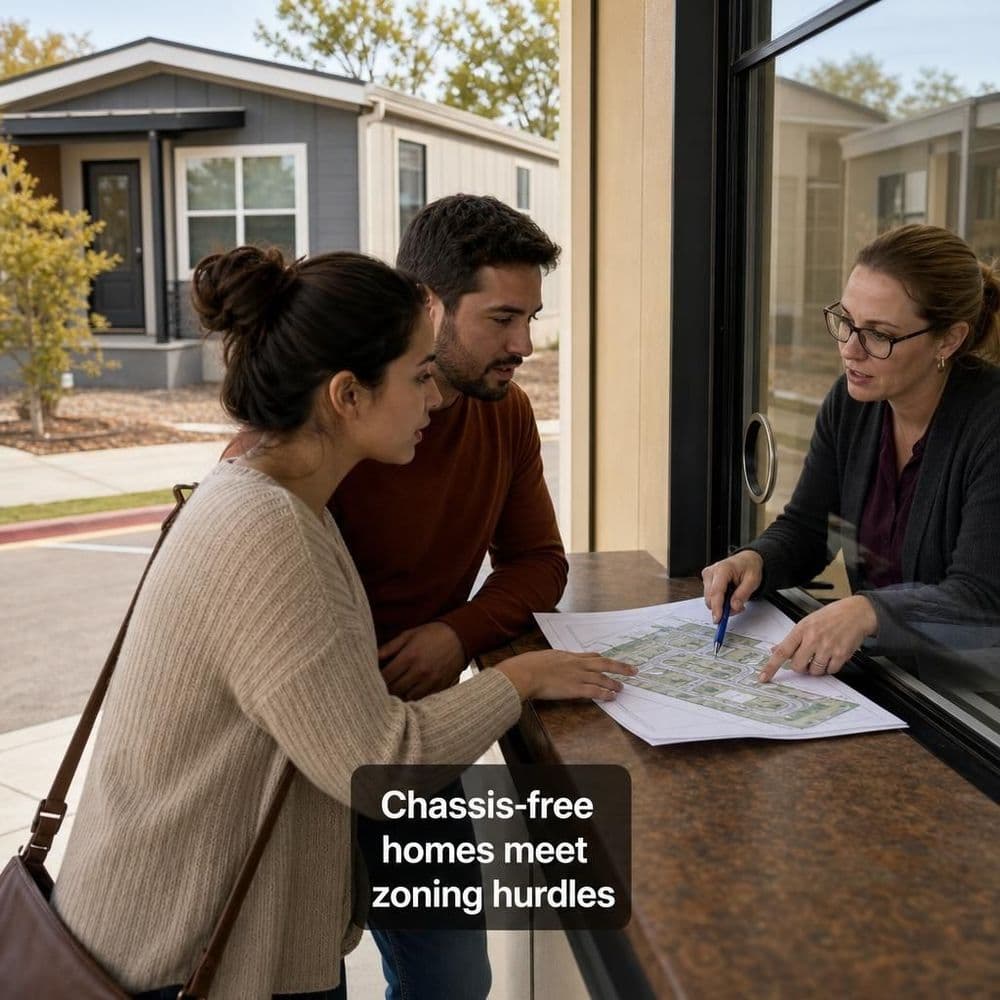
Manufactured housing is getting a technical reset
Manufactured housing has long been one of the most scalable ways to add lower-cost homes quickly. In 2026, a key federal change targeted one of the product’s most visible legacy features: the permanent steel chassis. Under the 21st Century ROAD to Housing Act, new manufactured homes can be built without that permanent chassis, and states are directed to ensure chassis-free homes receive comparable treatment for financing, titling, insurance, taxes, transport, and installation. [realtor.com][inman.com]
Why does that matter? Removing the chassis can reduce materials and open up more design flexibility, including options that look and function more like conventional site-built houses—potentially lowering neighborhood resistance that’s often rooted in appearance and outdated assumptions about the product. [realtor.com]
The catch: local zoning still decides what gets built
Even with a federal door opened, local land-use rules still determine where manufactured homes can go. Recent Realtor.com analysis (cited across industry coverage) found that only about 17% of zoned land nationwide explicitly allows manufactured-home communities. [realtor.com][realtor.com]
That statistic helps explain why production capacity alone won’t solve the starter-home shortage. Many jurisdictions block manufactured housing through:
- **Use restrictions** (not allowed in most residential districts)
- **Minimum floor-size rules** that eliminate smaller, entry-level formats
- **Architectural/design standards** that don’t match factory-built realities
- **Discretionary approvals** (special permits/conditional-use hearings) that add time and uncertainty
In practice, “by-right” placement—where a compliant unit can be installed without a political or discretionary vote—often determines whether projects pencil. [realtor.com][realestatenews.com]
Where the shift could matter most
Realtor.com’s research argues that the biggest lift from chassis-free manufactured homes may show up in metros that combine (1) relatively affordable land, (2) expensive traditional new construction, and (3) a low share of starter-home listings. In those markets, a cheaper factory-built option can fill a real gap—*if* local codes allow it. [realtor.com][realestatenews.com]
One reported ranking placed Hartford, Connecticut at the top of the list, followed by markets including Denver, Allentown, Albuquerque, and Colorado Springs. The common thread is not necessarily size; it’s the mismatch between entry-level demand and the cost structure of site-built delivery. [realestatenews.com][inman.com]
What to watch next (and what can actually move the needle)
The next phase is less about federal definitions and more about local implementation. Three practical signals to track:
1) **Zoning updates that expand by-right districts.** Allowing manufactured homes in more residential zones—paired with clear installation standards—reduces uncertainty and speeds up delivery. [realestatenews.com]
2) **Standards that reflect today’s product.** If rules were written for an older “mobile home” mental model, they can inadvertently ban modern units, especially as designs evolve post-chassis. [inman.com][realestatenews.com]
3) **State-level parity for paperwork and lending.** The law’s promise depends on how quickly states align titling, taxation, and financing treatment so chassis-free units don’t fall into a gray zone that spooks lenders and insurers. [realtor.com][inman.com]
Manufactured housing won’t be a universal fit, and it won’t overcome every siting constraint. But if jurisdictions want more attainable starter-home supply without waiting years for site-built delivery, the evidence in this week’s reporting points to one bottom line: federal policy can enable the product, but local zoning determines the pipeline. [realtor.com][realtor.com]
Comments