
Starter-home zoning reforms are stalling when local control wins
6 min read
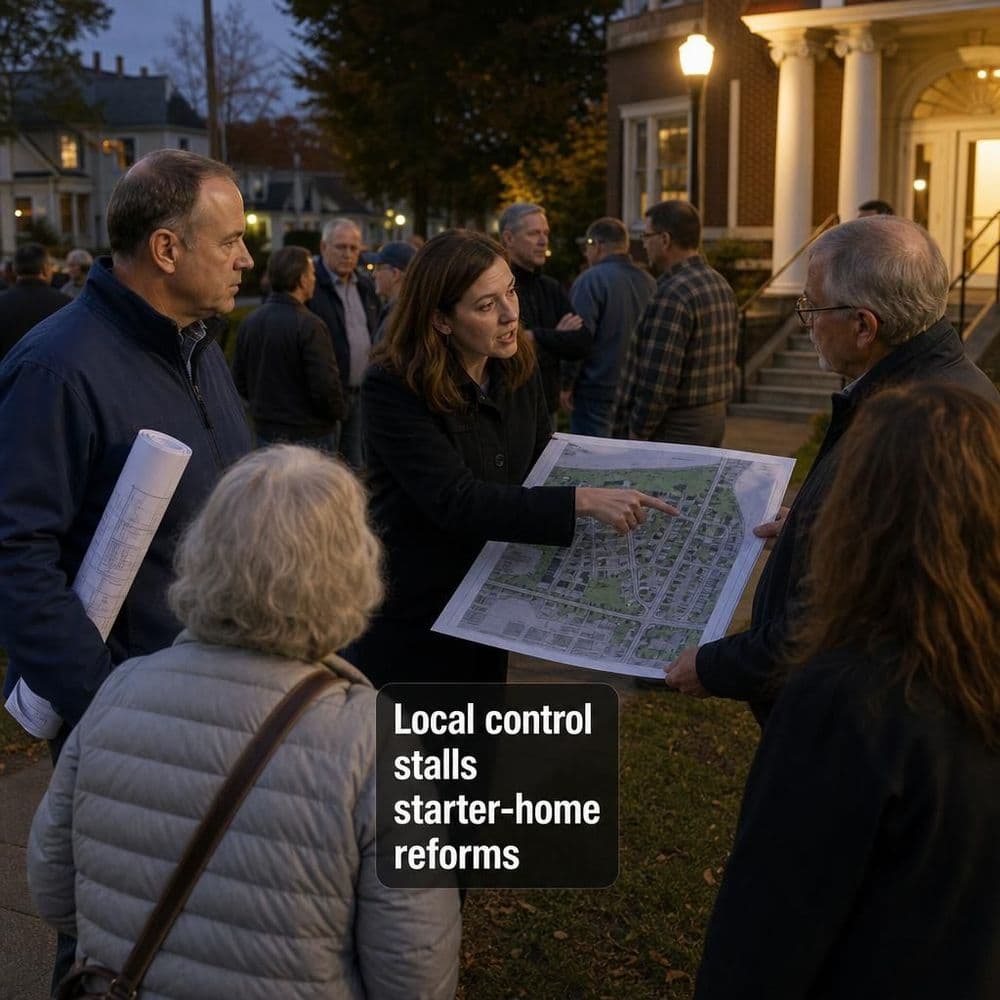
A statewide starter-home push meets a familiar obstacle: local control
Massachusetts voters narrowly rejected Ballot Question 7, a proposed statewide rule intended to make it easier to build smaller, more affordable single-family homes. The measure would have required cities and towns to allow single-family homes on 5,000-square-foot lots (subject to additional conditions), overriding stricter local minimum-lot zoning in many communities. [wgbh.org] [realtor.com]
The margin was razor-thin: Realtor.com reported the measure failed 50.6% to 49.4%. [realtor.com] GBH also noted the no vote won by just over 30,000 votes out of more than 2.5 million cast, per an Associated Press projection. [wgbh.org]
What Question 7 would have changed
Minimum lot size rules can quietly set the ceiling on how many homes can be built in a town — especially where single-family zoning dominates. Question 7 sought to establish a 5,000-square-foot minimum lot size for single-family homes statewide, with requirements including street frontage and access to public sewer and water. [realtor.com]
Supporters framed the measure as a starter-home supply tool: smaller lots can reduce land cost per home and make smaller footprints feasible. Opponents argued that a statewide mandate would remove local discretion and lacked enough affordability guardrails. [wgbh.org]
The same dynamic appears in project-level redevelopment fights
Even when statewide rules don’t change, communities still face site-specific decisions about whether to add housing. In Boston, officials have proposed redeveloping the aging Jackson Mann Community Center site in Allston by pairing a new community center with housing built behind it along Armington Street. [thecooldown.com]
Public comments show a familiar fault line: some residents argue the neighborhood has already absorbed significant development and oppose adding housing to the site, while others see it as a chance to meet both community-facility and affordability needs. [thecooldown.com]
What this means for starter-home policy in practice
The combined lesson from these two stories is less about one ballot question or one redevelopment plan, and more about implementation. Supply strategies can be designed at the state level, but the permitting reality still hinges on local rules, local processes, and local acceptance.
For builders and developers, that means pro-formas need to account for political and process risk — not just construction cost and interest rates. For state and local leaders, it means reforms that change what’s legal by right often face the steepest resistance, while more incremental approaches may advance faster but deliver smaller supply gains.
Watchlist
- Whether Massachusetts pursues narrower lot-size reforms, infrastructure-linked zoning changes, or incentive-based approaches after the close result. [wgbh.org] [realtor.com]
- How the Jackson Mann process evolves and whether housing remains part of the final plan. [thecooldown.com]
Comments