
Blog
How ADUs, Tiny Homes, and Pre-Approved Plans Are Expanding Affordable Housing Options
7 min read
August 2nd, 2026
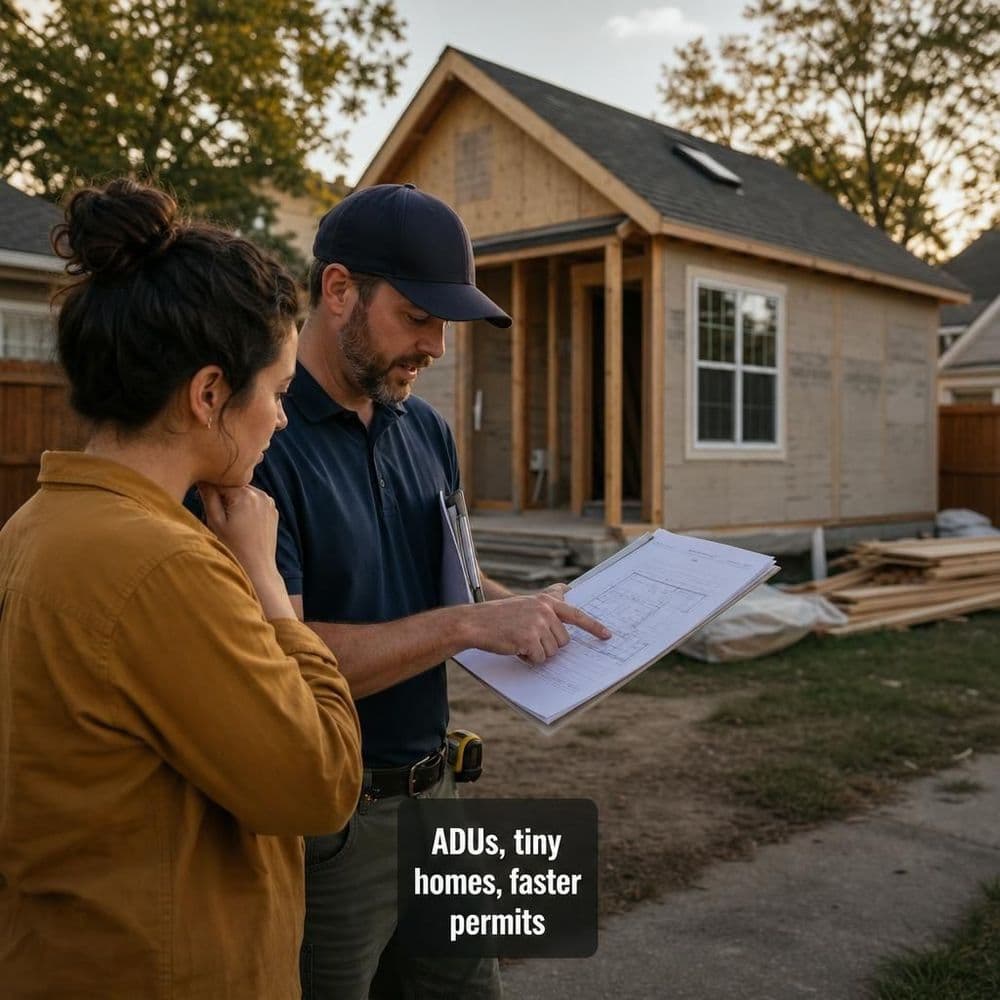
Why local governments are prioritizing small housing
Across the U.S., local officials are looking for housing solutions that can show results faster than a traditional multi-year development cycle. The most common thread is a pivot toward smaller, lower-cost unit types and faster approvals—especially where water, sewer, streets, and schools already exist.
These strategies don’t eliminate the need for larger apartment and subdivision projects, but they can add incremental supply and create more attainable options in neighborhoods that are already built out.
ADUs are the fastest path to gentle density
Accessory dwelling units (ADUs) are one of the most straightforward ways to add housing: a backyard cottage, an above-garage apartment, a converted basement, or an in-home suite. Because ADUs share a lot with an existing home, they often avoid the biggest cost driver in housing—new land. Pew notes that ADUs can be built relatively quickly and are among the lowest-cost ways to add homes, and that many states have moved to allow them on many or most single-family lots [pew.org].
A recent example comes from Viroqua, Wisconsin, where the local Housing Advisory Board advanced an ADU ordinance and has been working through practical issues like fire and ems access, utility hookups, and resident education. The city’s draft FAQ includes a minimum ADU size of 250 square feet, a rule that the ADU can’t be sold separately from the main home, and a deliberate choice not to add on-site parking requirements (to avoid forcing expensive new concrete pads) [vernonreporter.com].
Tiny homes: demand is rising, rules are catching up
Tiny homes are increasingly showing up in local conversations—often driven by resident demand rather than developer pipelines. But jurisdictions still have to answer basic questions: Are tiny homes treated like RVs? Are they allowed only on foundations? How are addresses, meters, and emergency response handled?
In Viroqua, the Housing Advisory Board said it’s receiving numerous inquiries about tiny homes, including tiny homes on wheels that residents want to place on existing lots. Board members discussed the appeal as a sub-100,000 dollar ownership option and floated the idea of a small tiny-home neighborhood with infrastructure supported through grants and loans [vernonreporter.com].
Pre-approved plans: cutting weeks out of permitting
Even when a project pencils out, timelines can kill it. Pre-approved plan programs try to remove that friction by creating a library of code-compliant designs that can move through permitting faster.
In the Kansas City area, local governments have launched portfolio home programs. Lawrence Journal-World reports that Kansas City, Missouri’s library includes designs for a duplex, two-story homes, and an ADU above a garage—and that the normal permitting timeline is estimated around six weeks, while applications using pre-approved designs can often be turned around in about 5 to 7 business days [www2.ljworld.com].
Pairing supply tools with affordability guardrails
Adding supply is a necessary condition for better affordability, but many communities also want near-term, income-targeted wins. One approach is to combine new construction with clear buyer eligibility and support services.
In Lexington, Kentucky, a new affordable homeownership development on Shropshire Avenue includes nine new single-family homes developed by the local housing authority, with five still available at the time of reporting. Eligibility includes being a first-time homebuyer, earning at or below 80 percent of area median income, and completing housing counseling and education through REACH Incorporated [wkyt.com].
Another strategy is preserving naturally occurring affordable housing (NOAH)—older homes and apartments that rent for less primarily because of age. Lawrence’s housing study recommends setting tools and goals for preserving NOAH, and points to examples in other cities that use acquisition funds or low-cost rehab financing to keep existing rentals affordable [www2.ljworld.com].
What to watch next
As these tools spread, the implementation details will matter as much as the headline reforms: how cities handle utilities and safety standards for ADUs and tiny homes; whether pre-approved plans are widely adopted by builders; and how affordability guardrails are enforced without slowing production. Pew argues that removing barriers can improve outcomes quickly, citing Minneapolis’ experience with regulatory changes and subsequent housing production and rent dynamics [pew.org].
The near-term takeaway: local governments are building a more modular housing toolkit—one that can add units faster, diversify options, and, when paired with targeted programs, create more attainable paths to rent or ownership.
Comments